New Ball State Men’s Basketball Coach Chris Capko Builds Program Around Character and Trust
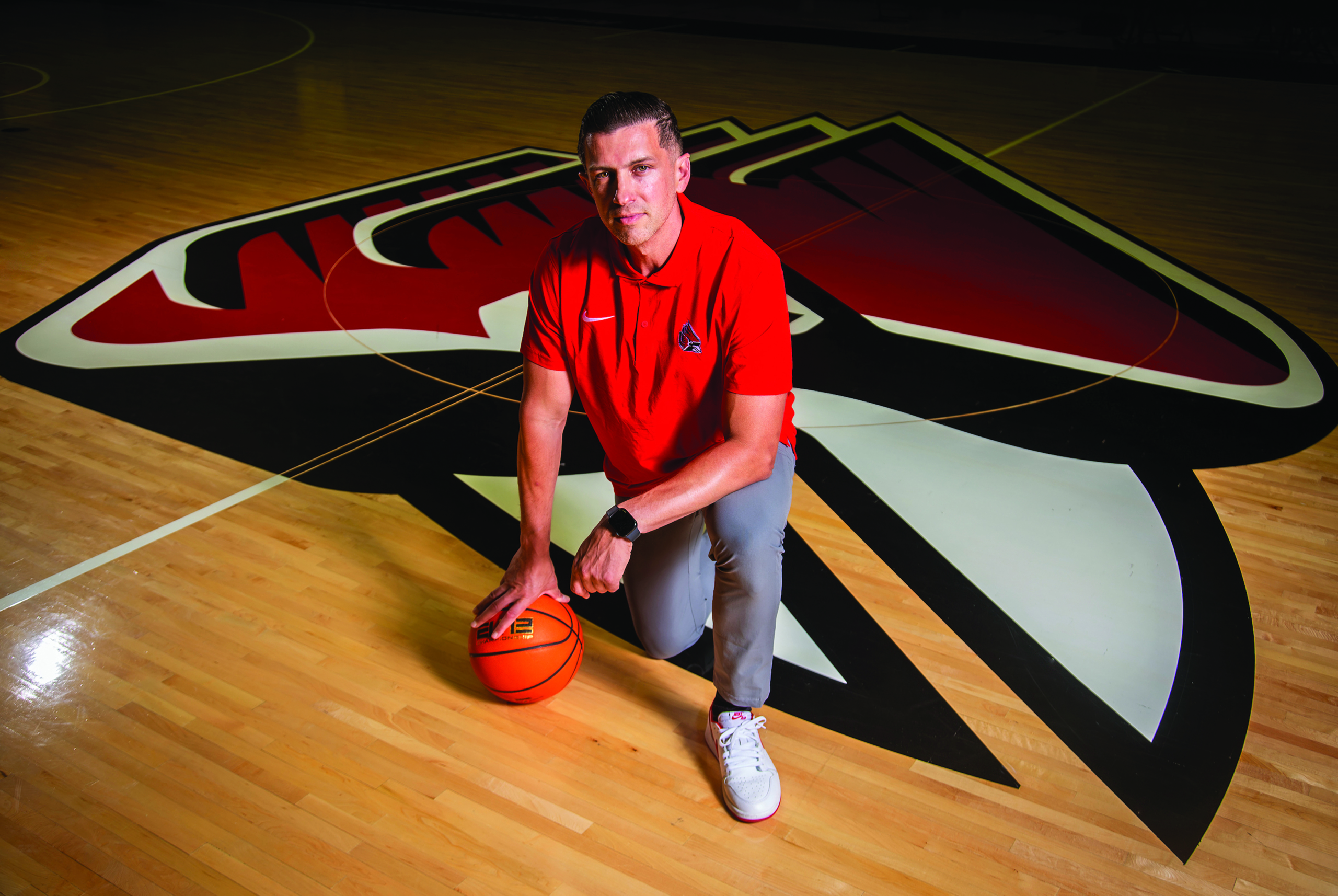
Chris Capko brings nearly two decades of Division I coaching experience to Ball State, where he is building the men’s basketball program around character, accountability, trust, and connection.
Chris Capko stepped to the podium, looked across a standing-room-only crowd in the Ball State Alumni Center, and stopped.
For several seconds, Ball State’s new coach said nothing. He had spotted friends and former colleagues he had not known would be there, and the weight of the moment caught up with him.
Coach Capko had spent 19 years working toward his first opportunity to lead a Division I program. Introduced in March as the 21st head coach in Ball State men’s basketball history, he took time to absorb it.
“I’ve been dreaming of this moment for a long, long time,” he said. “It’s just a surreal moment.”
Then he began describing what he intended to do with it.
Coach Capko arrived in Muncie after helping build winning programs across the country, most recently as associate head coach at SMU under Andy Enfield. Their decade together at SMU and USC included multiple NCAA Tournament appearances, an Elite Eight run with the Trojans in 2021, and the development of future NBA players.
Along the way, Coach Capko held nearly every job a college basketball program could offer: graduate assistant, director of operations, video coordinator, assistant coach, and associate head coach. Those roles gave him experience in recruiting and player development and in the less visible work of running a program.
“He’s performed every job at the Division I level,” Ball State Director of Athletics Jeff Mitchell said. “He’s prepared to be the head coach of our program at this time.”
Coach Capko’s path also taught him what opportunity can mean.
He began his coaching career when Donnie Jones offered him a graduate assistant position at Marshall. Other coaches later gave him new responsibilities, room to make decisions, and opportunities to advance. Coach Enfield eventually promoted him through several roles and became one of his strongest advocates for a head-coaching position.
Coach Capko sees his chance at Ball State as an extension of that history.
“As a coach and a leader of young men, I am in the business of inspiration,” he said. “It is my job to instill confidence, as well as to convey to my student-athletes that I believe in them.”
That does not mean lowering expectations. Coach Capko has described the program he intends to build as one grounded in character, toughness, honesty, and accountability. He wants self-motivated, dependable players willing to hear difficult truths.
During the hiring process, Coach Capko told Ball State President Geoffrey S. Mearns that a coach can be highly demanding without diminishing the people he leads.
“You can be demanding—you can be very demanding—but you don’t have to be demeaning,” President Mearns recalled of that conversation. “That is how we expect respect for all people.”
For President Mearns, the statement reflected why Coach Capko’s candidacy stood out beyond basketball strategy. He saw a coach whose work ethic and concern for players aligned with the University’s enduring values.
“He understands that basketball is really important, but things like family and friends and community are also important,” President Mearns said. “I’m just so impressed with his character.”
That alignment helped bring Coach Capko to Ball State.
As a highly regarded ACC assistant, he did not feel compelled to accept any head-coaching opportunity. He wanted university and athletics leaders who shared his ambitions and understood what it would take to compete in a changing college basketball environment.
He found that in President Mearns and Mr. Mitchell.
“The selling point was leadership,” Coach Capko said. “They are committed. They want to see me do well. They want to see the program do well.”
The work began immediately. Coach Capko assembled a staff with expertise in recruiting, player development, analytics, and professional basketball, as well as deep connections throughout the Midwest. He rebuilt much of the roster through the transfer portal while cultivating relationships with Indiana high school coaches and recruits.
On the court, he wants the Cardinals to play quickly, share the ball, make sound decisions, and score. During the team’s first Summer practices, however, he did not begin with a long list of plays. He emphasized effort, spacing, attention to detail, and playing together—the habits he wants established before the season.
He also wants the program visible beyond Worthen Arena. Coach Capko has invited fans, former players, coaches, students, and community members to attend practices and get to know his team. Building support, he believes, begins with giving people a reason to feel connected.
Near the end of his introductory remarks in March, Coach Capko recalled a question Mr. Mitchell had asked during their first meeting:
“Why not Ball State?”
After researching the program, speaking with University leaders, and seeing the community response, Coach Capko arrived at his answer.
“Why not Ball State? Why not us? Why not now?” he said. “We can be what you want this program to be. And I need everybody here to do that.”