Ball State Stage Makeup Students Bring Museum Art to Life
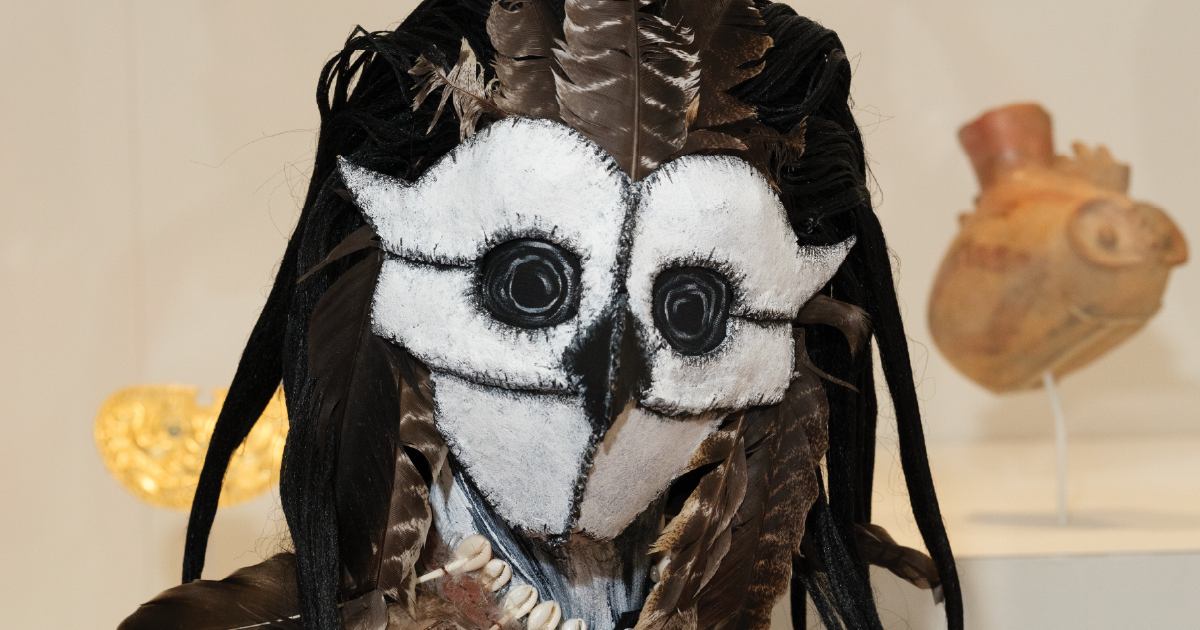 Ball State students transform works from the David Owsley Museum of Art into original stage makeup characters, then pose beside the art that inspired their designs
Inside the David Owsley Museum of Art, Ball State University students are studying the collection by turning works of art into fully realized stage makeup designs.
The project is part of THEA 429, Stage Makeup Design and Technology 2, an advanced course led by Robert E. Dirden, ’09 MA ’15. Mr. Dirden has 35 years of experience in theatrical design, including costumes, hair, makeup, properties, and scenic design; he began using the museum for versions of this class project about 15 years ago.
Students select works from the museum’s collection and use them as the foundation for original characters. They study each piece’s color, texture, shape, expression, and mood, then carry those details into makeup, hairstyling, prosthetics, costumes, and handmade elements. The course guides student designers from research and concept development through execution and presentation.
For the second year, the project culminated in a professional photoshoot inside the museum. Students returned in full makeup and posed beside the works that inspired them, allowing the photographs to show where each idea began and how it developed.
One project also brought student Samantha James together with Patricia “Pat” Nelson, George and Frances Ball Distinguished Professor of Art Emerita. Ms. James created a jester-inspired look based on Ms. Nelson’s sculptural teapot, drawing from its black-and-white beadwork, geometric patterns, and curved handle. Ms. Nelson attended the shoot and posed with Ms. James and the work.
The images that follow offer a closer look at those transformations and the creative choices behind them.
Mackenzie Crossland, ’26
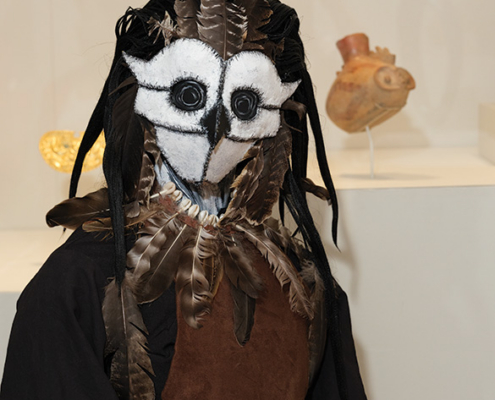 Mackenzie Crossland, ’26, based her ceremonial character on Effigy Vessel (fourth century B.C.), a sculpted earthenware work from Manabí, Ecuador. Ms. Crossland was drawn to the vessel’s owl-like appearance and to the freedom its abstract form gave her to develop an original character. Her research into the vessel’s funerary associations led her toward the idea of an owl-like shaman or death-god figure. She carried the reddish-brown tones of the earthenware into leather, beads, and feathers, while black and white suggested death, skulls, and bone. Seashells incorporated into the costume came from additional research into objects from the same culture and period. The finished mask remained close to her original sketch, even as she continued adjusting other elements of the look.
Johanna Bieszke, ’26
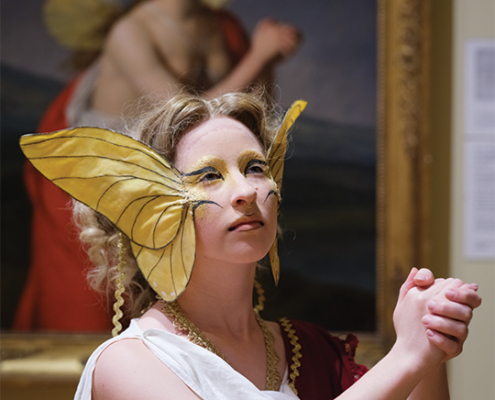 Johanna Bieszke, ’26, looked beyond the moment depicted in Jean Joseph Taillasson’s Psyche Abandoned by Cupid (1795). Drawn to Psyche’s expression and the theme of transformation in the myth, Ms. Bieszke imagined the character later in her story—more fully herself and ultimately becoming a goddess. The painting’s yellow butterfly wings became a central part of the design, reflecting the butterfly imagery often associated with Psyche and transformation. Ms. Bieszke also kept the story’s Greek setting in mind, basing her hair and costume on ancient Greek styles. She said the final result remained remarkably close to what she had envisioned and was pleased that the transformation she imagined came through in the finished look.
Ian Goodwin, ’26
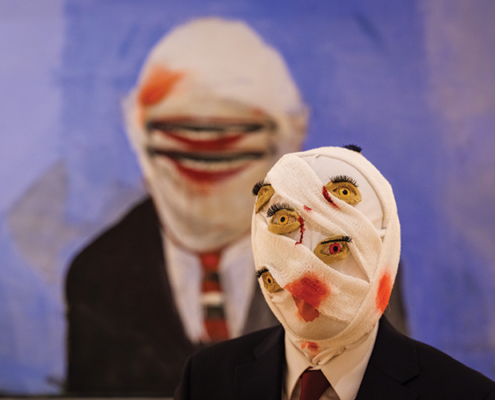 Ian Goodwin, ’26, gravitated toward Hiram Draper Williams’ Laughing Grad Against Blue (1964) because it felt different from much of the art surrounding it. Where many of the works he encountered emphasized beauty and elegance, Mr. Goodwin found this painting deliberately unsettling—and that quality appealed to him. He turned the painting’s blank white face and two mouths inside out conceptually, replacing the mouths with no visible mouth and adding multiple eyes between layers of bandages. A red streak in the painting became bloodlike markings in his design, while the suit and tie maintained another visual connection to the original figure. The concept evolved somewhat as he worked, but the finished character remained close to his initial vision.
Reese Walters, ’26
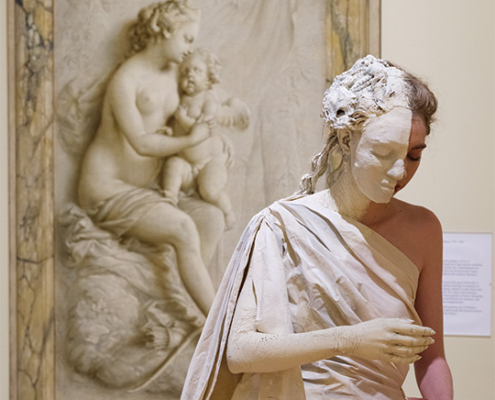 What first caught Reese Walters’ attention about Piat Joseph Sauvage’s Venus and Cupid (about 1775–1785) was how convincingly the painting mimics sculpture. Ms. Walters initially thought she was looking at a three-dimensional work, which led to the idea of creating a figure that seemed to be emerging from the painting itself. She studied close-up images to recreate the figure’s hair and carried small pearl-like details into her own design. She also drew from the marbling visible in and around the work, painting portions of the costume to sharpen the distinction between fabric and “stone.” Rather than dividing the two sides with a perfectly hard line, Ms. Walters allowed some areas to blur together—a choice she ultimately preferred to her original plan.
Samantha James
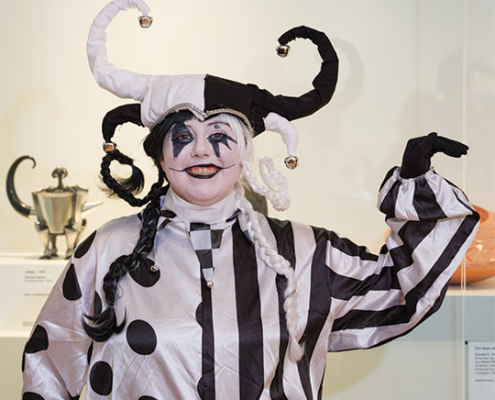 Samantha James knew quickly that Patricia “Pat” Nelson’s Jester (1998) was the piece she wanted to use. Ms. James already enjoyed carnival and circus imagery, and the sculptural teapot immediately suggested a jester character to her. She built the design around details in Ms. Nelson’s work: its silver surface, black-and-white beads, geometric patterns, and the pronounced curve of its handle, which influenced the shape of the handmade jester hat. Finding the right fabrics required some improvisation—including searching for checkerboard material among tablecloths—and one planned checkerboard section of the costume ultimately became a circular pattern instead. Ms. Nelson attended the photo shoot, polished the teapot beforehand, and posed with Ms. James and the finished design—an opportunity Ms. James described as especially meaningful.
Noah Butcher
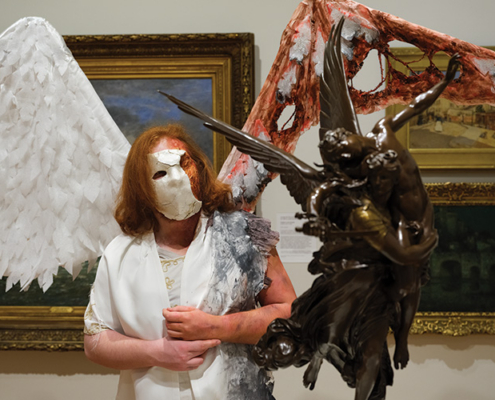 Noah Butcher’s interpretation of Antonin Mercié’s Gloria Victis! (about 1872) began with a misreading that became the heart of his design. At first glance, Mr. Butcher thought the sculpture showed a man carrying a wounded angel; he later realized that the winged figure was actually carrying the wounded man. But the first impression stayed with him, and he began imagining what a wounded angel might look like. Rather than closely reproducing the sculpture, he pushed the character toward something more mysterious and otherworldly. Large wings and injuries to the arms formed the basis of the design, while facial scarring and a mask developed later in the process. The mask, a relatively late addition, helped give the figure the sense of grief and wounded, unknowable presence Mr. Butcher wanted.
Ray Potter
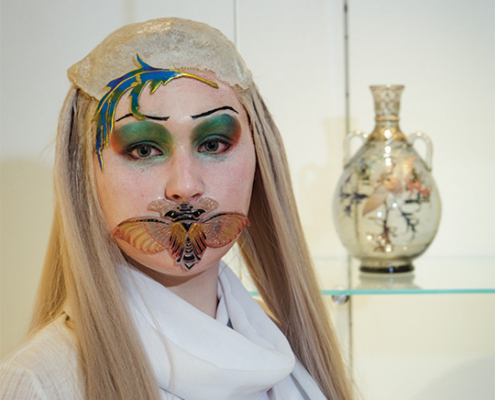 Émile Gallé’s Vase (about 1870–1900) stayed with Ray Potter long after first seeing it. Mr. Potter had considered several works for the assignment, but he said the vase was the one he could not get out of his mind. His design focused on the qualities he found most striking: the three-dimensional glasswork forming the winged insect, the transparency of the glass, and the gold detailing surrounding it. He recreated those elements through a reflective makeup base and placed the insect prominently across the mouth, attempting to capture the luminous quality of the original glass. Mr. Potter, now a sophomore studying theatre design and technology, said he was initially nervous about how the idea would translate—but the finished look exceeded what he had imagined.
Brenna Cleary
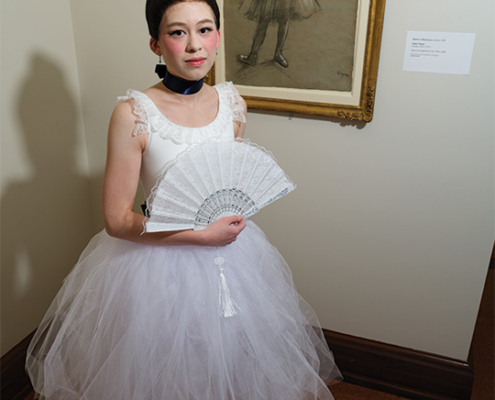 Edgar Degas’ Dancer (1885) connected Brenna Cleary with an earlier part of her own life. Before turning toward costume work, Ms. Cleary danced for about 10 years, and she remains connected to that experience. For this project, she looked at Degas’ drawing and imagined how the dancer might appear in color and onstage, developing a look based on a 1950s French ballet dancer. One of her favorite challenges was recreating the oversized ribbon bows used to tie ballet skirts, which required finding a way to make the bows hold their shape. She also adapted modern cosmetics to achieve the pale complexion and light pink blush she associated with the period. Ms. Cleary said the finished design ultimately looked much like what she had pictured when she began.