Curating a Legacy: David T. Owsley’s Transformational Impact on Ball State’s Museum of Art
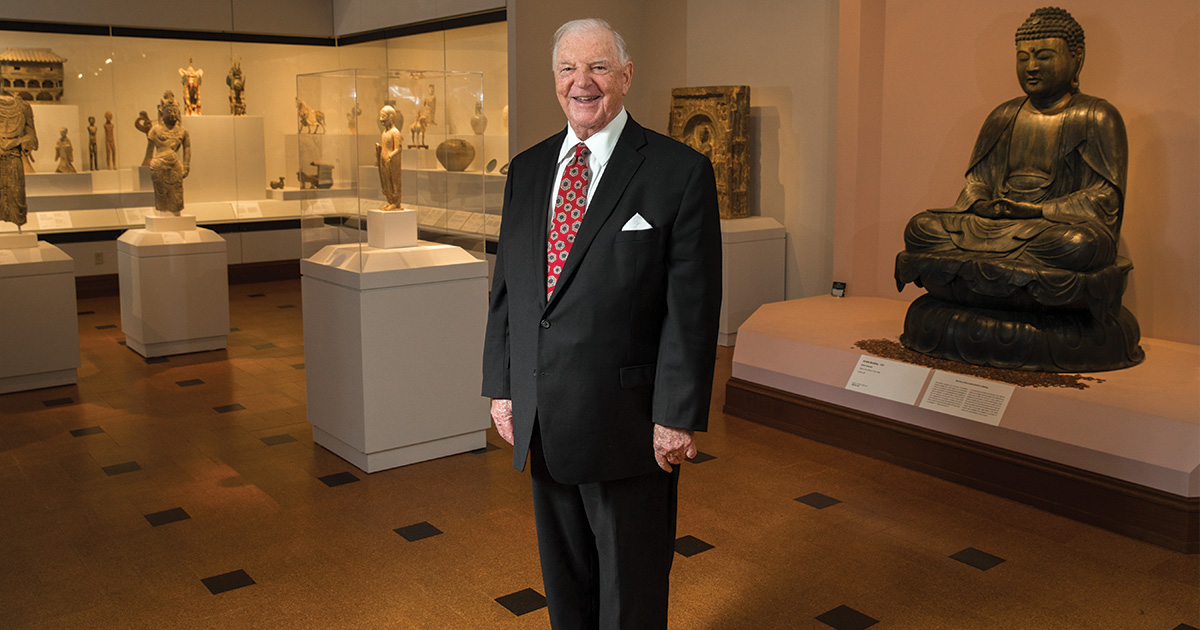
David T. Owsley, HHD ’05, stands inside the Ball State University art museum that bears his name in a 2016 portrait. Mr. Owsley died in August 2025 at the age of 96; his gifts continue to define the museum’s reach and ambitions.
For more than 60 years, scholar and benefactor David T. Owsley helped transform a modest campus gallery into the David Owsley Museum of Art, expanding its global collection and educational mission.
David T. Owsley, HHD ’05, was known professionally as a man of reserve. As a curator and appraiser, he built a reputation on exacting standards and serious scholarship—traits that defined his 60-year relationship with Ball State University. Through thousands of gifts, he quietly elevated a modest campus art gallery into a museum of global breadth.
But underneath the formal exterior lay a vibrant zest for life that occasionally took everyone by surprise.
At the museum’s 75th anniversary gala in 2011, Mr. Owsley stepped out of his role as the distinguished benefactor and onto the dance floor. Approaching Dr. Jo Ann Gora, then the University’s president, he led her to the center of the room.
To the delight of those who knew him primarily as a serious scholar, Mr. Owsley proved to be a masterful ballroom dancer, moving with practiced ease and sweeping the president across the floor in a moment of public, unforced joy. Dr. Gora later described it as an expression of Mr. Owsley’s “total comfort” and “pleasure in being there.”
It’s the kind of detail people cling to after someone is gone—not because it is grand, but because it is human. Mr. Owsley died in August 2025 at age 96, and in the months since, memories like that have returned time and time again—small moments that hint at the full, complicated life behind a name on a campus building.
Friends and family describe a man of striking contrasts. He could be quirky and exacting, worldly and intensely loyal. Mikael Darmanie, a pianist and close friend, called Mr. Owsley simply a “powerhouse” who “really liked to live.” Others recall a humor that could be sharp, even risqué—a wit that could see a situation and cut right to the heart of it. He loved a good party, yet lived in privacy.
And then there was his scholarly approach. Mr. Owsley was a scholar of decorative arts who resisted the idea that a university museum should be boxed into a single tradition. University leaders once assumed a smaller museum ought to focus; Mr. Owsley argued the opposite. The museum was “an educational program,” and range was the point. His commitment to the University’s mission was formally recognized in 2005, when Ball State awarded him an honorary Doctor of Humanities.
People who worked closely with Mr. Owsley described a vision that ranged widely; an ability to recognize quality across eras and cultures in a way most collectors never try to claim. You can see the results of his vision all over the David Owsley Museum of Art (DOMA) now: on label after label, the credit line repeats: “Gift of David T. Owsley.” In the galleries that broadened the museum’s reach—well beyond its traditional strengths in European and American art—his fingerprints are everywhere.
That story—how a boy with Ball family roots became a global traveler, curator, appraiser, collector, and finally the museum’s most consequential benefactor—doesn’t begin in Muncie. But it ends there, and it continues there, in gifts already on the walls and in others still making their way home.
A Life Shaped Elsewhere
David T. Owsley’s story carries the Ball family name, but it doesn’t move in a straight line.
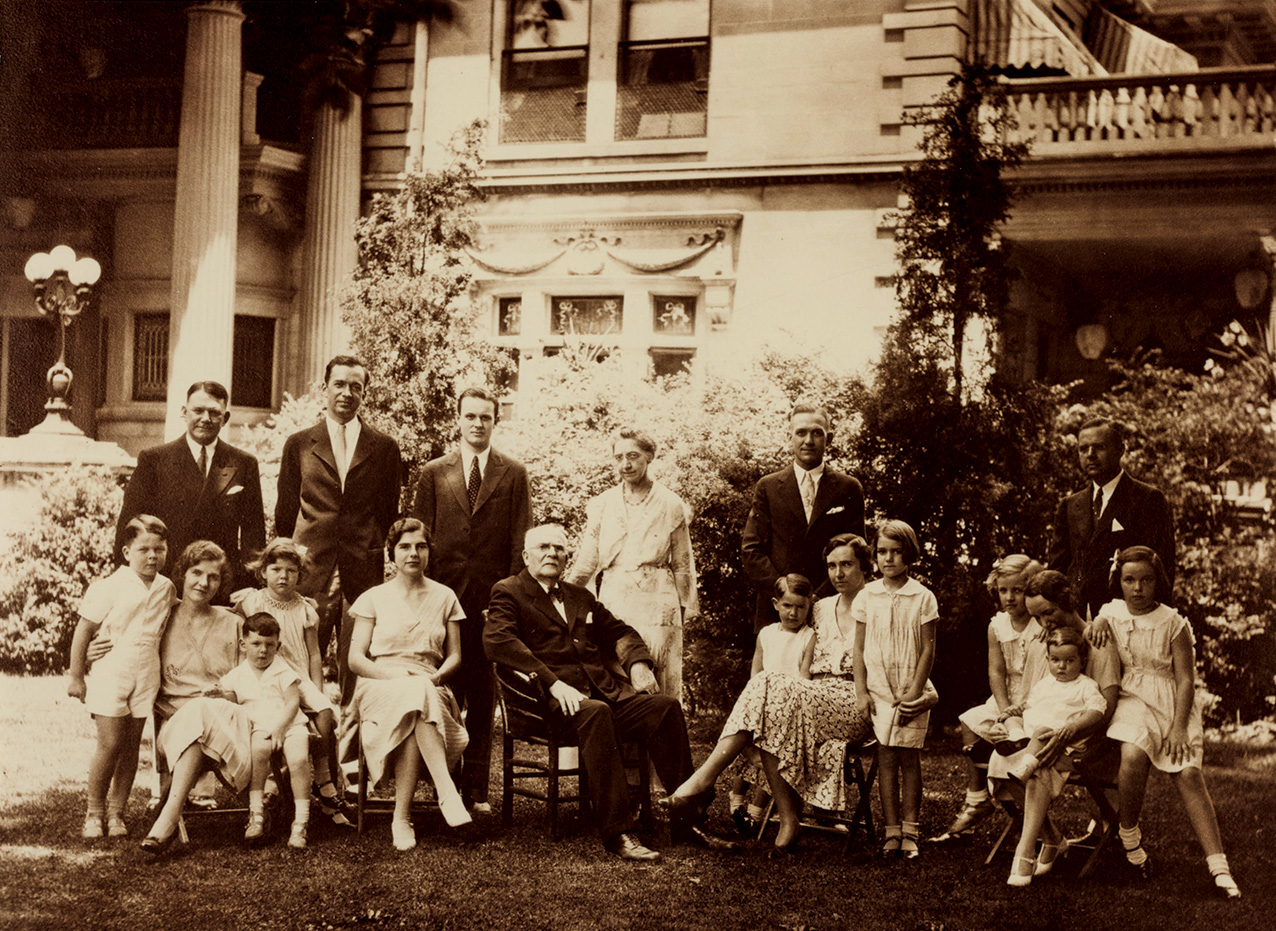
The Ball family at Minnetrista, July 1932. David T. Owsley (front, third from left) sits with parents Alvin Sr. and Lucy Ball Owsley at the Muncie home where he shared formative dinners with “Nana” (Elizabeth, back row) and “Grandfather Ball” (Frank C., seated center). Photo courtesy of Minnetrista Heritage Collection
Through his mother, Lucy Ball, he was the grandson of Frank C. Ball, one of the five Ball brothers whose industry and philanthropy shaped the University. His grandparents were lovingly “Nana” and “Grandfather Ball,” and the pull of Muncie starts there.
Mr. Owsley was born in Dallas in 1929, but much of his childhood unfolded far from Texas. His father, Alvin Mansfield Owsley, served in diplomatic posts in Europe, and the family lived abroad through the 1930s. These early years sparked a lifelong interest in places like Romania, Ireland, and Denmark.
When the family returned to the United States as war approached, they moved closer to his mother’s side. For Mr. Owsley, that meant Muncie—Sunday dinners at Minnetrista (his grandparents’ former estate along the White River in Muncie), weekends with cousins, and long stays with the grandparents who anchored him. For one year in high school, he even attended Burris Laboratory School on Ball State’s campus.
“Until I was 15, I thought more of Muncie as home than Dallas because Mother and I had stayed with Nana and Grandfather Ball … during several visits to the States,” Mr. Owsley wrote in his memoir.
That sense of home—tied to people, not geography—helps explain why a man who lived much of his adult life elsewhere, building his career and collection far from Indiana, continued to circle back to Muncie in memory and commitment.
From Madison Avenue to a Big Shift
After graduating from Phillips Academy and Harvard, where he earned a degree in English literature, Mr. Owsley enrolled at Harvard Business School with the expectation—his own and his family’s—that he would step into the Ball glass business. He even spent a summer in Muncie as a timekeeper at Ball Corp.
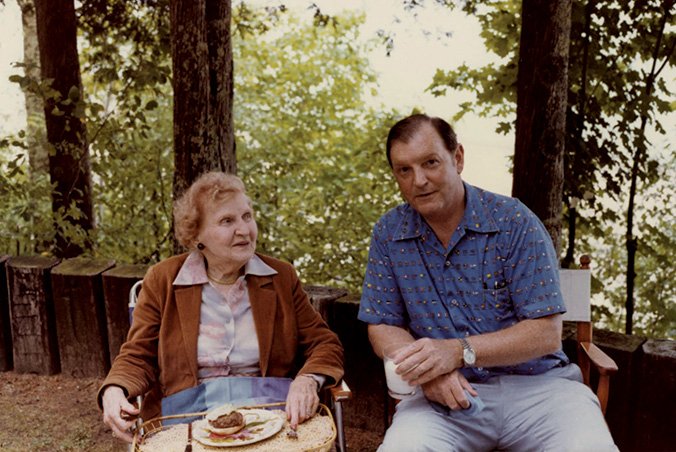
Mr. Owsley with his mother, Lucy Ball Owsley, in 1983. She championed his artistic ambitions; following her death in 1990, he honored her memory through his dedication to the University their family founded. Photo courtesy of Minnetrista Heritage Collection
Then the draft notice arrived. In 1951, Mr. Owsley was drafted into the U.S. Air Force during the Korean War. He taught in Air Force Intelligence and became a pilot, using his leave to fly himself to Mexico and California to buy art that caught his eye.
When he returned to civilian life, he took one more run at the “expected” version of his future, Stanford Law School, but left when the relentless reading brought on headaches. He pivoted again, landing at McCann-Erickson in New York, the global advertising firm.
He stayed long enough to become good at it—and long enough to feel uneasy about what he was selling. By the early 1960s, that discomfort sharpened into a decision. Mr. Owsley didn’t want a life built around persuading people. He wanted a life built around seeing; acquiring art, putting it in front of people, and giving it context. Dr. Robert La France, DOMA director, described it as a “crisis of conscience” that ended with Mr. Owsley choosing to become a curator.
At home, the choice landed unevenly. “She encouraged me and everything I ever did,” he said of his mother. Yet, his father was “opposed” to art as a career, telling his son, “Art is something to have once you’ve made your fortune.”
David Owsley went anyway. He trained formally at New York University’s Institute of Fine Arts and began building the life he wanted. In one of the family stories he liked to repeat, even his father’s resistance eventually thawed—helped along by a photograph from London: Mr. Owsley, in his museum work, pictured with Queen Elizabeth II.
The Making of an Eye
If Mr. Owsley was going to leave Madison Avenue for the museum world, he wasn’t going to do it halfway.
At NYU, he studied with major art historians and earned his master’s degree in 1964. From there, the résumé reads like a tour through institutions that shaped American collecting. A fellowship at the Metropolitan Museum of Art placed him alongside Philippe de Montebello, who would later lead the Met. A post at the Museum of Fine Arts, Boston, put him in charge of period rooms. Then came London and the Victoria and Albert Museum.
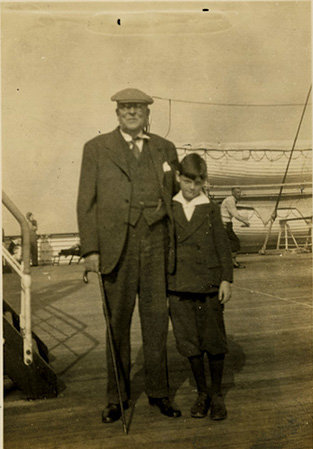
Mr. Owsley, 9, and grandfather Frank C. Ball aboard the Gripsholm, 1938. Frank, one of five Ball brothers who founded Ball State, represented a legacy of civic duty David later fulfilled through his commitment to the University’s art museum. Photo courtesy of Minnetrista Heritage Collection
By 1968, he was in Pittsburgh at the Carnegie Institute Museum of Art as curator of antiquities, Oriental art, and decorative arts—a sweep of responsibility that helps explain why so many people later struggled to pin him down as a “type” of collector.
The work wasn’t polite desk duty. It meant estates, travel, auctions, installations—the hunt and the judgment call. One of his most significant achievements there came through the estate of Ailsa Mellon Bruce, where he secured decorative arts for the Carnegie while paintings went to the National Gallery of Art.
In 1978, another turn: he stepped away from a curatorial post and bought an apartment near Park Avenue, starting a new chapter as a fine arts appraiser.
His client list included actor Christopher Plummer and the contents of Oakhurst, the charming Muncie home inherited by his cousin Elisabeth Woodworth Ball. But more telling is what that work allowed him to build in parallel: a private collection layered with pre-Columbian, African, Asian, European, and American art.
Years later, when Ball State President Geoffrey S. Mearns visited Mr. Owsley’s home, he recalled seeing paintings covering “virtually every inch” of wall space. Dr. Gora remembered the apartment as “like a museum in itself,” joking that Mr. Owsley had more art in his bathroom than many people had in their homes.
The point isn’t that he lived grandly (even though, at times, he did). It’s that the same habits show up everywhere: the close looking, the appetite for range, the insistence on quality. This wasn’t about price tags. Mr. Darmanie recalled that Mr. Owsley would happily wear a pair of $5 thrift store shoes over a $2,000 designer pair if the quality and look were right. It was about the quality, not the status.
Finding, Valuing, Studying
The first time David T. Owsley gave to Ball State, the museum didn’t carry his name. It was 1963, and the University’s collection was still known as the Ball State Teachers College Art Gallery.
In memory of his grandparents, Mr. Owsley donated a small group of works. At that point, he was still building the life that would make the rest possible. Over the years he would move comfortably between curatorial and appraisal work, gaining access to dealers and private collections. That blend mattered for Ball State.
Dr. La France describes Mr. Owsley as something rarer than a donor: a “curatorial partner” with the knowledge and means to shape a collection in real time. He could look at an object the way a curator does, talk about it the way an appraiser does, and, when it mattered, act decisively.
Dr. La France tells one story that captures the advantage. An Old Master painting came on the market, drawing interest from major institutions like the Met and the Getty. But while those museums had to convene committees and secure approvals, Mr. Owsley simply pulled out his checkbook. He bought it immediately, then sent it on loan to Ball State.
This efficiency extended to his communication. Dr. La France noted, with a laugh, that Mr. Owsley was famous for his phone habits: he rarely said hello, and never said goodbye. When the business was done, when the decision was made, he simply hung up. The work was what mattered.
Reshaping a Museum
By the time Ball State began receiving major works from Mr. Owsley, he already knew what a museum could do in a person’s life. He had trained seriously and lived for decades in a city where museums were part of the daily landscape.
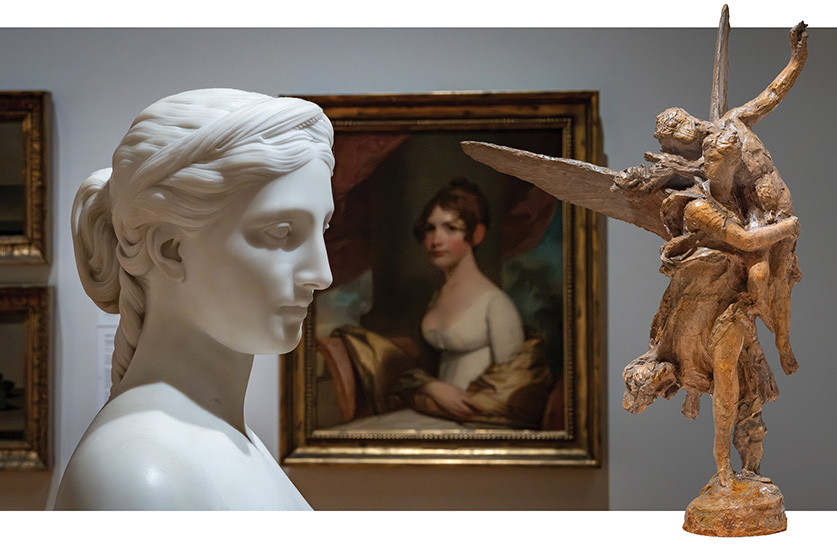
Left: Hiram Powers’ marble bust Proserpine (1844/49) was gifted by David Owsley in honor of Dr. Thomas and Frances Petty Sargent. Its Neoclassical style reflects the Greco-Roman and Italian Renaissance traditions long favored by Mr. Owsley’s family. Center: Gilbert Stuart’s Portrait of Anne Eliza Allston (c. 1808) is a centerpiece of the Elisabeth Ball Collection. Gifted by the George and Frances Ball Foundation, it reflects the family’s early impact on the museum’s permanent holdings. Right: A plaster cast of the esquisse for Antonin Mercié’s Gloria Victis! (1872) was the museum’s first acquisition through the Lucy Ball Owsley Memorial Fund (pictured). Mr. Owsley later bought a bronze replica for the museum, dedicating it to director Dr. Robert La France.
That perspective shaped what he wanted for Ball State. Dr. Gora remembers arriving in 2004 with a common assumption about smaller museums: pick a lane, build a specialty. Mr. Owsley pushed back. He saw the museum as part of a university’s teaching mission—“an educational program,” in Dr. Gora’s words—and he wanted it to offer students more than one tradition or region.
He backed this vision with action. Dr. Gora recalled that Mr. Owsley and then-director Peter Blume developed a close working partnership that often involved going shopping together. “Whatever caught David’s eye, he would buy, and then he would give it to the museum,” she said. It was a partnership built on a specific, curated intentionality—a level of professional trust that extended to Dr. La France when he took the helm in 2014, ensuring the museum’s growth remained both ambitious and deeply personal.
President Mearns calls the museum one of Ball State’s distinguishing assets; few universities of its size and age have a collection as high-quality and as broad in scope. And he connects Mr. Owsley’s generosity to a principle that’s easy to overlook: the museum remains free of charge.
None of that existed in isolation from Mr. Owsley’s own history. Karen Vincent, ’87 AA ’87, former director of collections at Minnetrista Museum and Gardens, places his commitment inside a longer Ball family tradition—one that includes deep support for the arts across generations. For Mr. Owsley, the museum became a place where those threads met: family, education, community, and the lifelong practice of looking closely.
A Museum That Could Hold the World
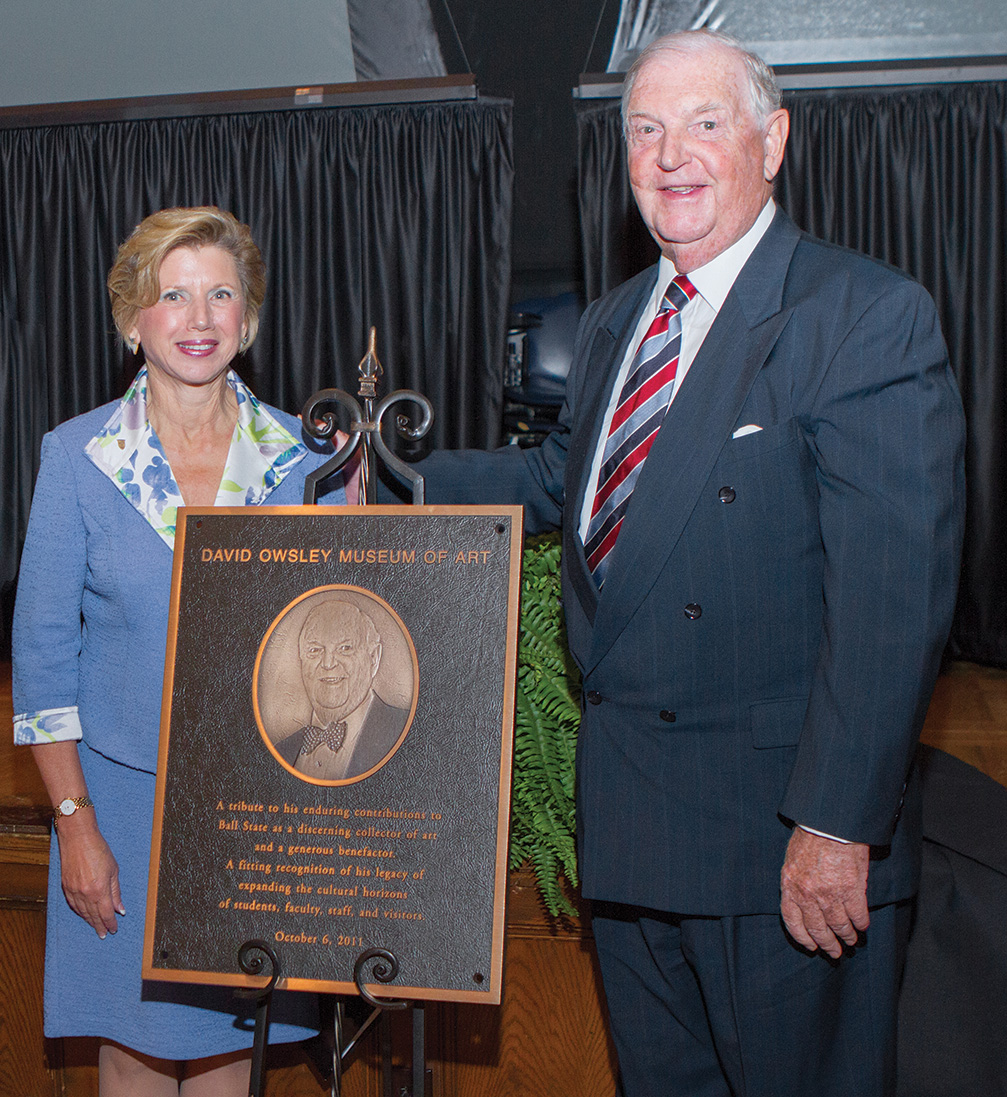
David T. Owsley and former Ball State President Dr. Jo Ann Gora (left) at the 2011 ceremony renaming the University’s Museum of Art in his honor. Once housed in high school corridors, the collection moved to campus in 1918. After major expansions in 2002 and 2013, the museum now occupies a world-class footprint—a transformation Dr. Gora credited to Mr. Owsley’s “extraordinary expertise” and lifelong generosity.
By the time the Museum of Art carried Mr. Owsley’s name in 2011, it already had a long memory. A gallery space first opened on campus in the former library (now the West Quad Building) in 1927, followed by a more permanent home in the Fine Arts Building in 1935. Over the decades, directors and champions kept pushing the collection forward, building credibility and expanding what a campus museum in Muncie could be.
Mr. Owsley simply encountered something already underway, then used a lifetime of training and a collector’s stubborn patience to accelerate it.
Dr. La France describes the throughline as a simple ambition: bring art of the caliber found in major cities to the students and people in Muncie. The museum’s best-case moment is when a Ball State student stands in a museum in New York or Chicago and says, almost casually, “We have one of those in Muncie.”
You can point to objects that make that sentence plausible. Dr. La France mentions a Jacques Lipchitz sculpture added in 2013, or a Lee Krasner painting important enough that the Metropolitan Museum of Art plans to borrow it for an exhibition this Fall. In that kind of moment, the museum stops feeling “regional.” It becomes part of a national—and even international—conversation that invokes the museums, countries, and cultures that Mr. Owsley studied.
Generosity that Lasts
By the time of Mr. Owsley’s passing last August, his relationship with Ball State’s museum spanned more than six decades, from his first gift in 1963 to thousands of donations that steadily reshaped what the museum could teach.
The story doesn’t end with what is already on the walls. Dr. La France said the “lion’s share” of what remained in Mr. Owsley’s New York apartment is coming to Ball State, along with his library and documents. These materials matter for the museum’s next chapter: the ability to build exhibitions from depth and to place works in context for students who will never have met the man who chose them.
Taken together, it means the museum will keep changing in visible ways: new objects entering the collection, new research made possible, new exhibitions shaped by the materials he left behind. Mr. Owsley spent a lifetime bringing the museum closer to the standard he carried with him. The collection he built for Ball State will keep arriving, and the museum will keep building from it.
In a sense, these final shipments represent a homecoming. While Mr. Owsley spent his life in the global centers of the art world, he often invoked his mother’s voice and the principles she taught him. The values that guided his decisions in New York were rooted in the Ball family legacy he first encountered at Sunday dinners with his grandparents at Minnetrista.
To understand why Ball State was never a side note in his life—why it kept drawing him back—those who were close to him point to this interior map. For Mr. Owsley, what mattered was where the work landed. And what it made possible.
“There’s a lot to say about David, but even though he traveled around the world, moved in important circles, and studied at places like Harvard and Stanford, he kept coming back here,” Dr. La France said. “They say home is where your heart is, and Muncie was where David’s heart was. He’s given us a gift that will last for generations. I appreciate that—and I think we all should.”