
How Ball State’s CSH Success Hub Is Helping Students Stay On Track
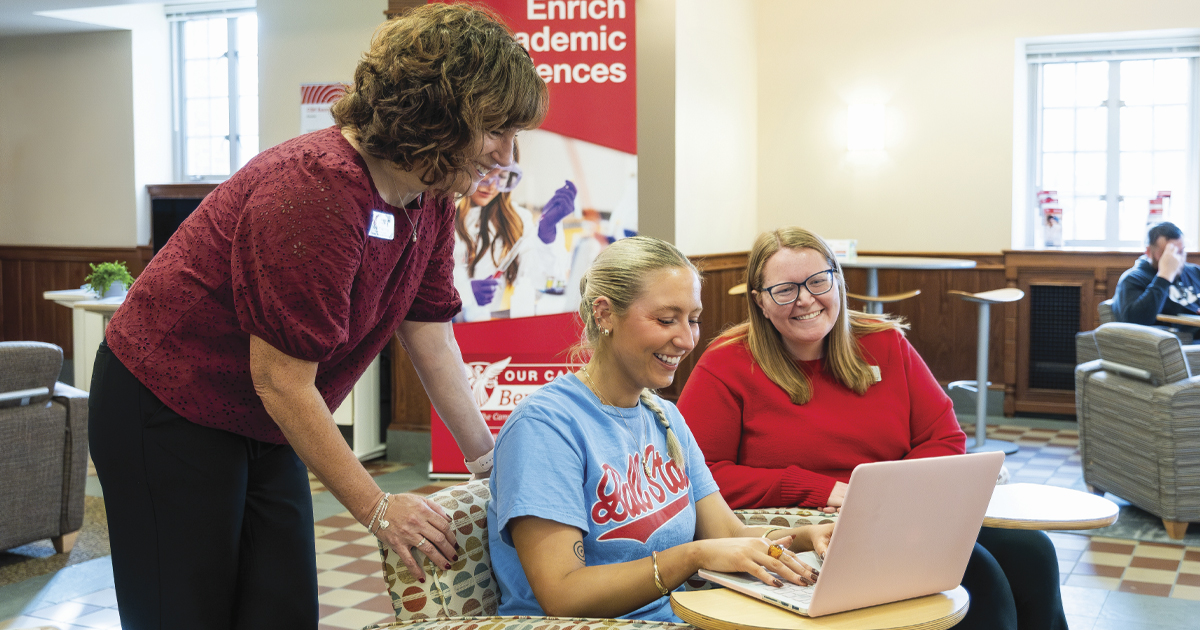
Dr. Melisa Ellis Stevens, ’91 MA ’98, (left) and Sarah Sager (right) meet with senior Caroline Erny in the CSH Success Hub housed in North Quad—an approachable entry point to personalized support across the College of Sciences and Humanities.
The College of Sciences and Humanities Success Hub combines personalized student support, course redesign, and faculty collaboration to help more Ball State students persist in demanding majors.
When Caroline Erny, a senior psychological science major, first stepped into the College of Sciences and Humanities Success Hub in North Quad, she wasn’t looking for help in the traditional sense. She was between classes and curious about the space she kept passing every day.
“I wandered in one day because it felt like a comfortable place to sit and work,” Ms. Erny said. “I didn’t really know what Success Hub was or what they did.”
While spending time in the hub, Ms. Erny struck up a conversation with Dr. Melisa Ellis Stevens, ’91 MA ’98, assistant dean and director of student success for the College of Sciences and Humanities. What began as an informal chat soon evolved into a more in-depth conversation about life after graduation.
“At the time, I was set on pursuing a PhD and becoming a professor,” Ms. Erny said. “Dr. Stevens asked me about my goals, what I liked about my major, and what I wanted my life to look like after college. It didn’t feel like a formal appointment, but it ended up being exactly the guidance I needed.”
Later, when Ms. Erny began to question whether a doctoral program was the right path, she returned to the hub for another conversation. This time, Dr. Stevens helped her think through alternative options that aligned with her interests—particularly her growing enthusiasm for statistics, research, and data visualization.
“She helped me connect the dots,” Ms. Erny said. “I realized I love analyzing data and presenting research in ways that could help organizations make decisions. That sounds more like the career I want. I probably wouldn’t have put that together on my own.”
Now, Ms. Erny spends even more time in the hub working as a student success ambassador, where she sees students studying between classes, checking in for appointments, needing directions to an office, or stopping by between commitments.
“A lot of students come in casually, just like I did,” she said. “But once the staff gets to know you, they check in. It’s informal, which makes it less intimidating.”
“There’s this idea that college is supposed to be completely on your own,” she said. “But at Ball State, it doesn’t feel that way. I feel like a lot of times, students just don’t know where to go, and that’s okay. The success team can figure it out with you. There’s always someone you can reach out to, and that makes a huge difference.”
Ms. Erny’s experience reflects a broader focus on student success that Ball State University has advanced since 2022 through coordination by the Student Success Initiatives team in University College, providing personalized support, targeted outreach, and practical resources to students across every major and every college. Each college has its own student success staff, ensuring students can access consistent support, while also allowing colleges to develop initiatives that meet the unique needs of their students.
In the College of Sciences and Humanities (CSH), that focus has a central home: the CSH Success Hub in North Quad. The hub is a welcoming space that serves as a daily home base for students. It’s a place to regroup, connect to resources, receive support, and keep moving forward in demanding academic programs, including many of the University’s most rigorous science pathways.
How the CSH Hub Began
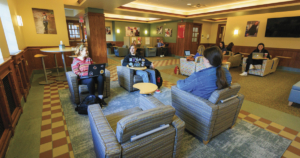
More than a study space, the CSH Success Hub (below) is where early outreach, questions, and conversations help students address challenges before they derail progress in demanding majors.
When Dr. Stevens arrived at Ball State in late 2022, she was shown an empty room in North Quad and given a bold charge: build something that could transform how CSH supports students.
“It had some old chairs and bare walls,” Dr. Stevens said. “But it was a space and an opportunity. I wanted to create a place where students could walk in, take a breath, and know they belong.”
Opening in August 2023, the CSH Success Hub has become a bustling gathering place, with more than 5,500 student visits during the last academic year. Appointments scheduled through the University’s Navigate system grew by 300 percent, and daily traffic doubled from the previous year.
Dr. Stevens leads the hub alongside Sarah Sager, assistant director; two graduate assistants; and three undergraduate student workers. With this small team, the hub runs what Ms. Sager calls “an academic emergency room.”
“Students come in with all kinds of needs,” Ms. Sager said. “We may not know everything, but we know everybody. We listen and figure out what kind of help they need, whether that’s academic support, counseling, or just someone to remind them they’re doing better than they think.”
Sometimes that help means connecting a student to tutoring or counseling. Other times, it means helping them untangle a schedule, figure out how to communicate with a professor, or talk through a problem.
Unlike traditional academic advising, which Ms. Erny described as goal-oriented and transactional, student success appointments are more personal and exploratory.
“With advising, there’s usually a specific outcome—registering for classes or changing a major, which is also very helpful,” she said. “Appointments with staff in the CSH Success Hub, though, it’s more like, ‘What are you struggling with?’ or ‘What are you unsure about?’ It goes deeper.”
The hub’s rapid growth reflects a University-wide commitment to student opportunity and success, a pillar of the Our Call to Beneficence campaign. Through Student Success Centers such as the CSH Success Hub—along with expanded scholarships, microgrants, advising, and coaching—the campaign reinforces a simple belief: access to higher education should be driven by students’ potential, and every student deserves steady, personalized support to thrive at Ball State.
“The CSH Success Hub shows exactly what we mean when we talk about student opportunity and student success,” said Tiffany S. Barnes, ’94, director of development for the College of Sciences and Humanities. “The campaign helps ensure that centers like this, and the people who run them, have the resources to assist students every step of the way.”
Results that Speak for Themselves
From the start, the hub’s mission has been practical and compassionate. Leadership within the College of Sciences and Humanities wanted success to be measurable, especially in high-impact gateway courses that can determine whether students persist in STEM pathways.
The college has targeted introductory courses where failure and withdrawal rates once hovered around 30 percent. Focused collaborations between faculty, department leaders, and the dean’s office are producing measurable gains in key gateway courses.
Drop/Fail/Withdraw (DFW) rates in MATH 125 fell from 30 to 21 percent, and in ANAT 201 from 28 to 22 percent. Biology courses also improved through a pilot outreach that identifies struggling students early. Together, these efforts represent a CSH-wide approach to student success, strengthening retention, redesigning high-impact courses, and rethinking teaching practices to better meet student needs.
The point, Dr. Stevens says, isn’t to “make things easier.” It’s to make success more attainable through earlier intervention, clearer course design, and teaching that recognizes the skill sets students have.
Rethinking Teaching
The progress in assisting students is also tied to a shift in perspective.
“We’ve moved away from that old mindset of ‘look to your left, look to your right—one of you won’t be here next semester,’” Dr. Stevens said. “That was never kind or productive. We owe it to our students to meet them where they are and help them move forward.”
CSH has supported a change in philosophy through the Pedagogy Fellows Program, which empowers outstanding faculty to lead teaching innovation across 14 departments. The Fellows host workshops, maintain a faculty learning network on Canvas, and encourage instructors to share strategies. Their work helps ensure that teaching excellence remains a central component of student success.
The work also reflects who CSH students are today. Many arrive academically capable, but they are still learning how to navigate college life, particularly in demanding majors.
“We’re seeing a generation that’s academically strong but sometimes underprepared for the social and logistical parts of college life,” Dr. Stevens said. “They’ve learned in very different ways. Our job is to help them build confidence, community, and balance.”
Approximately 40 percent of CSH students are Pell-eligible, and nearly 38 percent are first-generation college students. Those realities can change the kinds of support students need and when they need it.
“Not every student has someone at home who knows what FAFSA (Free Application for Federal Student Aid) is or how to talk to a professor,” Ms. Sager said. “So, we help fill in those gaps.”
Sometimes outreach begins with an attendance alert through Navigate from an instructor. Sometimes it’s a student who wanders in after getting a nudge email.
“Sometimes students will walk by the hub and say, ‘Oh, you emailed me. Can we talk?’” Ms. Sager said. “That’s where we can intervene and try to set them on the right path again.”
STEM Education Center expands pathways for future teachers
Officially launched Jan. 14 to coincide with Ball State Day at the Statehouse, the Ball State University STEM Education Center is a new hub for advancing STEM teaching and learning across Indiana. Housed in the College of Sciences and Humanities, the center was developed through collaboration among Associate Dean Dr. Richard Petts and Center Director Dr. Andrew Gatza.
The center’s mission is to expand access to high-quality STEM instruction, grow the pipeline of future STEM teachers, and position Ball State as a state and national leader in STEM education. It serves as a central point for youth programs, school and community partnerships, and faculty-led research, creating pathways that connect elementary through college students with meaningful STEM experiences.
Core goals include increasing the number of science education majors at Ball State, redesigning teacher preparation to emphasize hands-on learning and classroom innovation, and strengthening collaborations with K-12 schools through initiatives such as summer STEM camps, family STEM nights, and professional development workshops for educators.
The center also supports an interdisciplinary network of faculty whose research shapes evidence-based STEM teaching practices. By securing external funding and translating scholarship into classroom strategies, the STEM Education Center helps ensure that teachers, schools, and communities have the tools they need to prepare the next generation of STEM-ready graduates.
Events that Open Doors
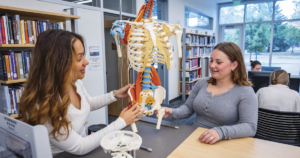
In addition to the Success Hub, the CSH library is available for study and collaboration, making success more attainable while maintaining strong academic expectations.
The hub is intentionally communal. It’s a place to study, meet with advisors, or connect with classmates and student organizations.
“Cardinal Classics has been grateful to use the CSH Success Hub,” said senior creative writing major Ruth Hartje. “The space was incredibly comfortable and welcoming—perfect for our book discussions and meeting activities. The staff at the hub were extremely helpful, even assisting us with setting up the technology to support our presentations. It’s truly a great resource.”
The hub coordinates events that tie academic work to life after graduation and help students visualize pathways for their degrees. Events include the Star Party for humanities and social science majors, the Midwest Actuarial Science Student Conference, the Central Indiana Severe Weather Symposium, and the annual Outdoor Career and Internship Fair, which connects students to employers in natural resources, conservation, and emergency management fields.
“We wanted to spotlight careers where individuals work outdoors—careers that students don’t automatically think of,” Ms. Sager said. “And it’s become one of our most popular events.”
The hub also partners with the Department of Political Science for the Law School Exploration Series, featuring admissions representatives and alumni from Indiana University’s Maurer and McKinney schools of law. Other events, such as Careers with Meaning, which showcases alumni working in nonprofits and community service, help humanities and social science students see the broad value of their degrees.
Sustaining Momentum for Students
The hub team plans to deepen partnerships across campus and expand peer-mentoring opportunities, allowing students to see themselves in others who have navigated similar challenges. The long-term goal is to provide seamless support from the day they arrive on campus to graduation day.
For Dr. Stevens, the work remains rooted in the simple belief that when students feel seen, heard, and supported, they do better, even in the most demanding majors.
“We have incredible students,” she said. “They come with so many different experiences, and sometimes they just need someone to walk alongside them. Our academic programs are challenging—but our students are up for the task. They’re resilient, determined, and capable. We’re just here to remind them of that when they forget.
“If we want to grow our communities and strengthen our state, we have to help students achieve their goals,” Dr. Stevens added. “That’s what this work is really about: investing in people who will lead Indiana’s future.”
Building collaboration into CSH’s structure
Dr. Petra Zimmerman
The student success mindset is now shaping how the College of Sciences and Humanities (CSH) organizes itself. In Fall 2025, CSH launched the School of Earth, Atmosphere, and Sustainability (SEAS), merging geography and meteorology with environmental science, geology, and natural resources, and created the Department of Anthropology and Sociology. Classical cultures and religious studies programs moved into the Department of History, resulting in updated department names in Modern Languages and Cultures and Philosophy.
The reorganizations aren’t cosmetic. They centralize resources, make interdisciplinary teaching more natural, and expand real-world, workforce-aligned learning opportunities—especially in science and environmental fields, where collaboration mirrors professional practice.
Dr. Petra Zimmermann, inaugural director of SEAS and former chair of the merged departments, said the goal is to connect faculty, researchers, and students with shared questions and complementary strengths.
“We’re bringing together scientists, researchers, and students who have many shared interests to develop innovative programs, collaborative projects, and to give students more opportunities to grow as they work towards their fulfilling careers and meaningful lives,” Dr. Zimmermann said.
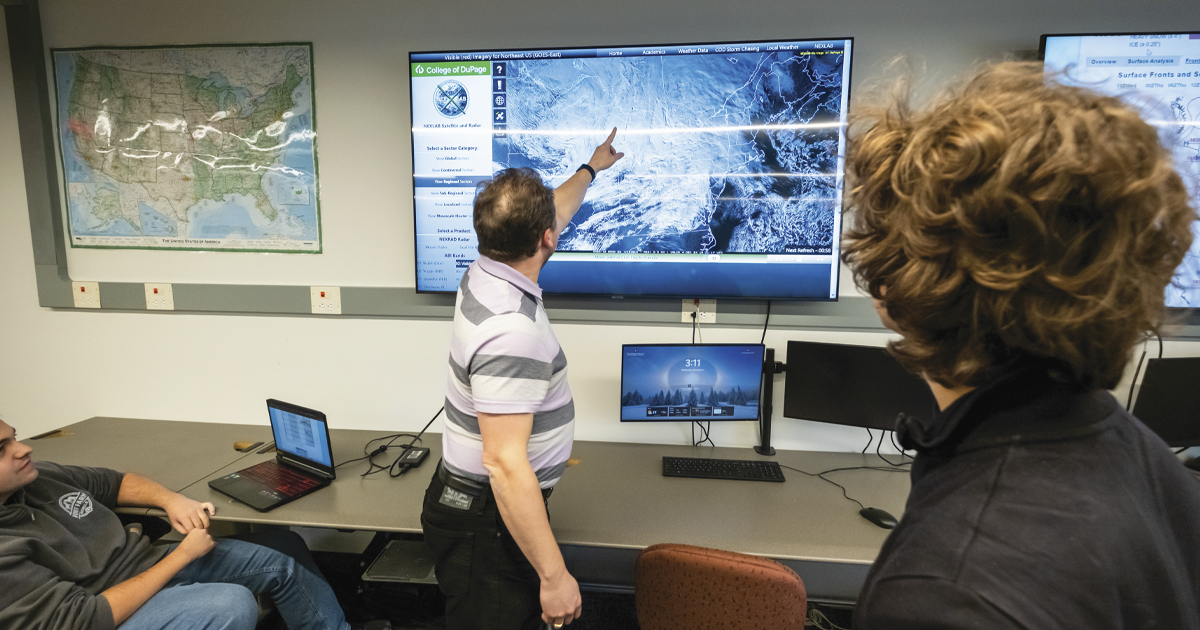
Meteorology students analyze weather patterns within the School of Earth, Atmosphere, and Sustainability.


