Ball State Alumni Find Their Place in America’s Parks and Conservation Lands
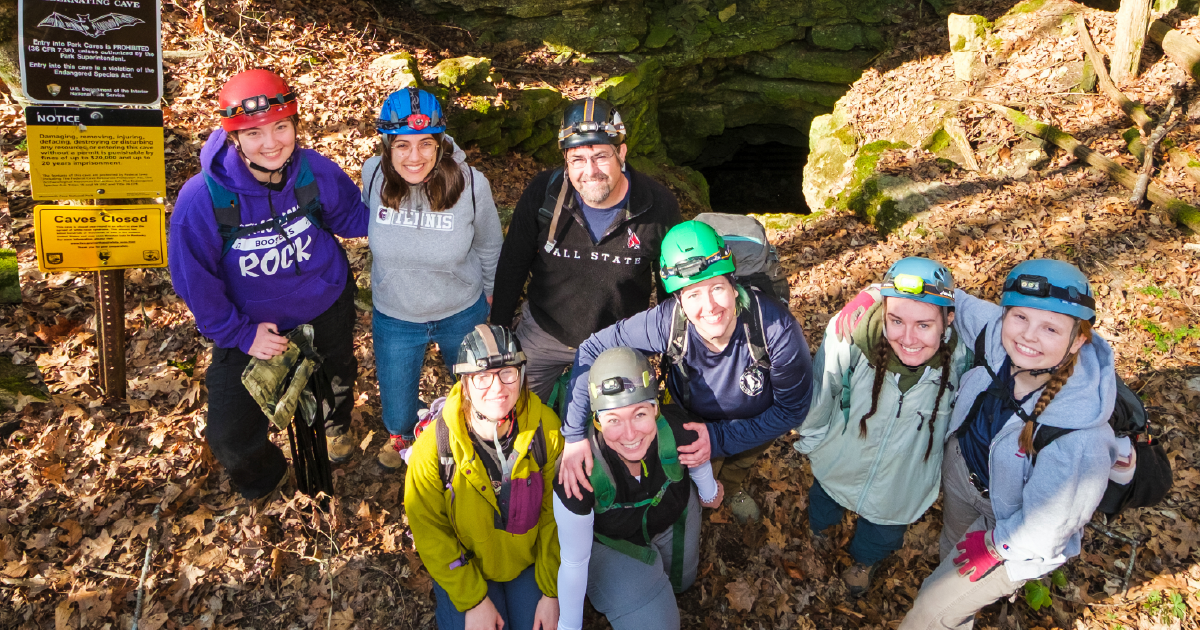
From Mammoth Cave to wildlife refuges across the country, Ball State students and graduates are applying science, field experience, and public-service skills to protect treasured landscapes.
Every national park, wildlife refuge, and conservation area tells a different story. Some preserve ancient geology. Others protect migratory corridors, old-growth forests, or coastlines that have never been developed. What they share is a need for people who understand those places deeply—and who can help the public understand them too.
Ball State University has been answering that call for decades—equipping students with the expertise and preparation these places depend on.
Across the country, Ball State graduates are working as researchers, conservationists, wildlife biologists, public lands managers, and more. Their paths have taken them to state wildlife agencies, national wildlife refuges, conservation organizations, and national parks. What connects them is a foundation built in Muncie—one that, their professors and peers say, prepares graduates for the intersection of science, public service, and environmental stewardship in ways few programs can match.
The evidence is visible at Mammoth Cave National Park, where the connection between Ball State and the park runs deeper than most would expect. Dr. Scott Bergeson, MA ’12, came to Ball State as a graduate student in Dr. Tim Carter’s wildlife biology lab. He is now an assistant professor at Purdue University Fort Wayne and one of the main bat biologists for Mammoth Cave National Park.
Now, Dr. Bergeson and Dr. Carter are collaborating on research to track the migration of endangered bat species.
“Our students really excel because they’ve got a good general understanding of a whole host of different things,” said Dr. Carter, department chair of the Department of Biology, director of the Field Stations and Environmental Education Center, and professor of biology at Ball State University. “No matter what the topic might be, they’re able to have an intelligent conversation.”
Into the Field
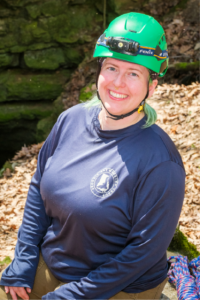 One of the clearest illustrations of that preparation is unfolding right now, deep inside Mammoth Cave.
Helle Cavalieri, a second-year environmental sciences PhD student at Ball State, is tracking the migration of the federally endangered Indiana bat—work that sits at the urgent edge of North American conservation. White-nose syndrome, a fungal disease that has devastated bat populations across the continent since arriving in the United States in 2006, has triggered population declines of more than 90 percent in some species. Understanding where these bats go when they leave their hibernation sites could be critical to protecting them.
Cavalieri’s research uses Motus tags—small transmitters glued carefully to a bat’s back—to follow individual animals as they scatter across the landscape. A nationwide network of passive receivers picks up the signals, tracing migration routes that researchers are only beginning to understand. For Cavalieri, that mystery is precisely what drives the work.
“Where do they go? We don’t know where they go yet,” Cavalieri said. “It’s just really, really cool to have the opportunity to be a part of finding out.”
The fieldwork is equal parts science and improvisation. On deployment days, teams move through the cave collecting bats, processing each one for species, sex, age, and weight, and attaching transmitters—all within a narrow window designed to minimize stress on the animals. When cave ceilings are too high to reach, the solution is practical: an extendable golf ball retriever, looped gently around a bat’s toes, brings it safely down from the wall.
On equipment days, solar-powered monitoring stations lose charge when the Summer forest canopy fills in, and Cavalieri has hiked 30 minutes into the woods carrying replacement batteries that weigh 55 pounds.
“I did not realize how much handiness was going to come into it,” Cavalieri said. “I’ve learned a lot about wiring. Don’t electrocute yourself.”
Cavalieri has worked with bats for more than seven years, and only in the past year has been able to encounter the northern long-eared bat—a species once so common that biologists barely bothered to document them.
“Getting five of that species is exciting,” Cavalieri said. “But it’s also sad. It’s really sad that getting five of a species is exciting.”
Building the Pipeline
 The connection between Ball State and Mammoth Cave extends well beyond a single research project. For more than a decade, Dr. Carter has brought students to the park, giving them opportunities to move beyond the classroom and take an active role in the work of wildlife biologists.
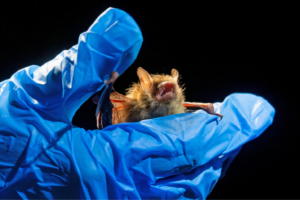
That experience is perhaps most visible during Bat Day, an annual Labor Day weekend event that gives park visitors an up-close look at bat research and conservation. After dark, Dr. Carter and his students set up mist nets—fine mesh nets used to safely catch bats—and process the bats in front of visitors standing just a few feet away.
Earlier in the day, students step into another role—helping the next generation see bats through the eyes of a biologist. During the park’s “Being a Bat Biologist” Junior Ranger program, they use stuffed animals in place of real bats to walk children through the same steps researchers use in the field—weighing, measuring, and recording data.
“It’s helping to instill in the next generation an appreciation for bats rather than a fear of them,” Dr. Carter said. “From my students’ perspective, they absolutely adore this.”
Their role at Mammoth Cave extends beyond public education. The students who make those trips are also active participants in the research.
“We could not conduct that research without them,” Dr. Carter said. “They are a central part of that work.”
For many, those experiences become preparation for what comes next. Former students from Dr. Carter’s lab have gone on to careers as state wildlife biologists, conservation researchers, and wildlife managers across the country—a track record he said reflects what Ball State’s biology program is built to do: give students broad ecological knowledge and the hands-on experience needed to step into careers on public lands.
That alignment between the biology program and the needs of conservation employers is part of what makes Ball State graduates so well prepared, Dr. Carter said.
“Our students are already well-suited for those positions because of that similarity of goals,” he said.
Showing Up
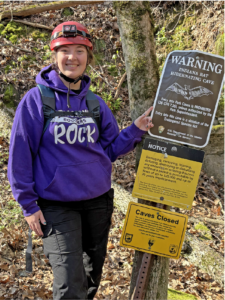 Senior Jessica Hougland has always loved the outdoors. Visiting some of the most beautiful places in the country at a young age, she said, made her want to protect them so others could experience them too.
A biology major with a concentration in wildlife biology and conservation and a minor in environmental management from Seymour, Ind., Ms. Hougland will graduate in December. She joined Dr. Carter’s team at Mammoth Cave after spending Summers working with the U.S. Fish and Wildlife Service at Muscatatuck National Wildlife Refuge, and has also been active in The Wildlife Society at Ball State—an involvement she credits, alongside her time in the lab, as among the most formative decisions of her college career.
“I hope that students feel like they can get involved and put themselves out there,” Ms. Hougland said. “Even if I would have been turned down to be in his lab, I am proud of myself for reaching out and putting myself out there.”
She already knows what comes next.
“I really enjoy being out in the field and not behind a desk,” Ms. Hougland said. “I want to be able to help the different species on whatever property I am working.”
It is a sentiment Cavalieri understands well. The work at Mammoth Cave carries a weight that goes beyond research questions and field seasons.
“I am really thankful for the people who have kept going through that,” Cavalieri said. “People like Tim. He was one of the very first people who was sent pictures of bats with white nose before they even knew what it was.”
That spirit—of showing up for the work even when the answers are uncertain, and the losses are real—is what Ball State has been cultivating in its graduates.
Across America’s national parks, wildlife refuges, and conservation lands, those graduates are putting that preparation into practice.