
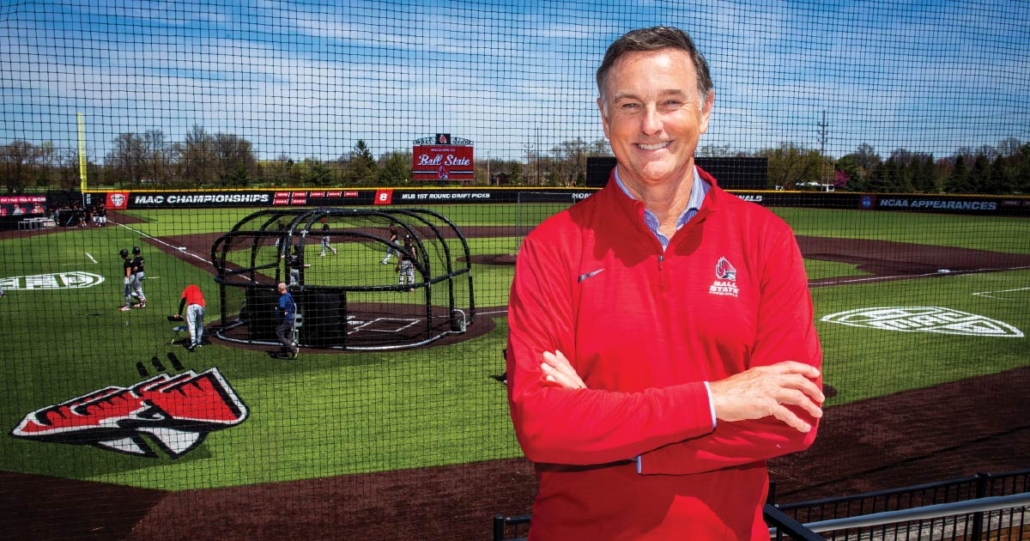
Former standout pitcher Mike Shebek, ’88, poses for a photo inside Shebek Stadium, named in his honor in February 2025 in recognition of his enduring impact on Ball State baseball—on and off the field.
From ace pitcher to CEO, Mike Shebek, ’88, has built a life defined by resilience. His journey came full circle with a historic contribution to Ball State baseball and the stadium that now bears his name.
Mike Shebek, ’88, still remembers taking the mound during the 1984 IHSAA semistate baseball tournament—his North Central High School team facing Muncie Southside, with a trip to the state finals on the line. He came in confident, riding a dominant season, thinking his velocity would carry the day.
But that didn’t end up being the case.
“They were hitting my fastball all over the yard,” Mr. Shebek recalled. “I had to throw all curveballs. I got them out that way the rest of the game.”
It was a turning point in the game—and, in hindsight, a fitting metaphor. That quiet adjustment under pressure would come to define Mr. Shebek’s life. From early baseball success at Ball State to the disappointment of limited professional opportunities, from a humbling exit from the family business to the launch of his own company, Mr. Shebek’s story is built on resilience and reinvention.
Now, decades later, he’s made perhaps his most lasting contribution—not from the mound, but through a $5 million gift to Ball State and its baseball program. It’s a legacy shaped not by dominance, but by knowing when to make a change.
Finding his place
Mr. Shebek’s path to Ball State began with a coincidence. Pat Quinn—then still in the early years of building the Cardinals’ baseball program—had made the drive to North Central High School in Indianapolis to scout an infielder. But midway through the game, the skipper’s attention was drawn to a pitcher coming in from the bullpen.
“I actually saw Mike play the first time by accident,” Coach Quinn recalled. “I went to North Central to look at a shortstop. Probably about midway in the game, they brought in a tall right-hander, loose and free, and it was Mike Shebek.”
From that point forward, Mr. Shebek kept proving himself. He finished his senior season with a 13–1 record and anchored one of the top high school teams in the state. Coach Quinn later called that year’s recruiting class—led by Mr. Shebek—“probably the best pitching class” he brought in during his entire Ball State tenure.
What stood out to Coach Quinn even beyond the talent was Mr. Shebek’s grounded nature and closeness with his family. “Very early in the recruiting process it was clear he was close to his family,” Coach Quinn said. “I got the feeling he had done his homework on Ball State… I didn’t have to do a whole lot of recruiting to get him.”
Once on campus, Mr. Shebek earned a spot in the starting rotation as a freshman—a rare feat for any college pitcher. Ball State lacked many of the amenities common in today’s programs: there was no pitching coach, no weight coach, and no clubhouse. But that era of Cardinals baseball was built on toughness, trust, and team culture.
“We were all just a bunch of guys grinding,” recalled teammate Lex Hunter, ‘88. “But we believed in each other.”
The players grew close—many of them living on the same dorm floor—and learned to compete with what they had. Mr. Shebek didn’t draw attention to himself, but teammates and coaches alike noticed his steadiness under pressure. “He was just low key, a great competitor, and never got rattled,” Coach Quinn said.
Mr. Shebek’s family remained a fixture. His parents rarely missed a home game, and his sister Lori, ‘88—already a Ball State student—organized the Batgirls, who assisted with field prep and gameday operations.
By the time he graduated, Mr. Shebek had helped lay the groundwork for what Ball State baseball would become—and forged relationships that would follow him long after his final pitch.
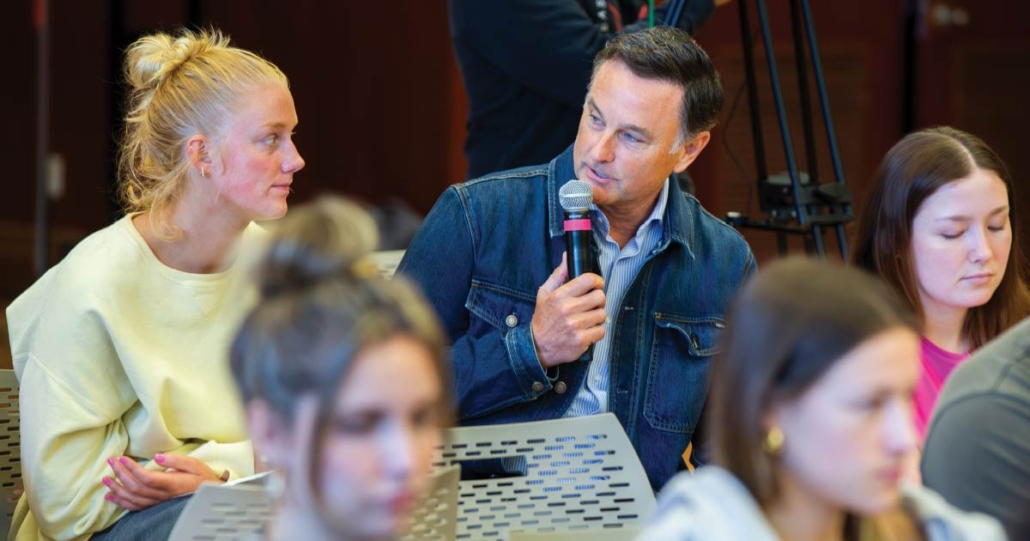
Mike Shebek speaks during an Entrepreneurial Experience Lecture hosted by the Miller College of Business in April. Mr. Shebek majored in foundations of business, interpersonal relations, and general studies at Ball State, graduating from the University in 1988.
A new direction
As Mr. Shebek reached his junior year at Ball State, he was becoming as thoughtful about life off the field as he was dominant on the mound.
He’d arrived on campus as a telecommunications major, but something shifted. He began gravitating toward business courses—especially those taught by Dr. Ramon Avila, ’77 MBA ’79, a professor known for blending classroom concepts with real-world insight.
Dr. Avila, who would go on to develop Ball State’s nationally recognized Center for Professional Selling, brought a dynamic, hands-on approach that resonated with Mr. Shebek.
“His class gave me a whole new way to think about how organizations work,” Mr. Shebek said. “It wasn’t just theory with him. He had energy and a real-world approach. It made an impression.”
That impression stayed with him long after graduation. Years later, he returned to campus as a guest speaker, reflecting on how those early lessons in sales and leadership shaped the way he approached his own company. “It just stuck with me,” he said. “And it turned out to be pretty relevant.”
But during Mr. Shebek’s time in Muncie, baseball still came first.
He was a fixture in the rotation—tough, durable, and unshakable. He remains Ball State’s all-time leader in career shutouts (eight) and ranks second in both career complete games (25) and innings pitched (337.0). He is also third in career strikeouts (257) and tied for fourth in career games started (55). In 1987, his talent was recognized at the next level when he was selected in the 38th round of the MLB Draft by the Baltimore Orioles.
He didn’t sign.
Instead, he returned to Ball State for his senior season in 1988, hoping to improve his stock and earn a better opportunity—one that never came.
“I was hoping to get picked up by a team or have an opportunity,” Mr. Shebek said. “But it just didn’t happen. That was hard. I had spent all this time focused on baseball. And then, suddenly, it was over.”
Coach Quinn saw the same potential—still puzzled at how his ace never got another look.
“You just never know,” Coach Quinn said. “Mike had the stuff. He had the mentality. But sometimes the break doesn’t come.”
Mr. Hunter remembered the moment, too. “It was hard watching guys like Mike not get a shot,” he said. “He deserved one. No question.”
What came next wasn’t what Mr. Shebek had pictured for himself. Baseball had been his singular focus, and now, for the first time, the path forward wasn’t obvious.
But Mr. Shebek had always been good at adapting. When the fastball stopped working, he went to the curveball. And when pro baseball didn’t pan out, he pivoted again—this time into the family business.
Starting from scratch
With baseball in the rearview, Mr. Shebek returned to Indianapolis and joined his family’s business, a company that installed automatic pool covers in Indiana. He jumped in with energy and ideas, helping modernize operations and streamline production. For a while, it worked. The company was growing. He was helping lead the way.
But over time, philosophical differences emerged—particularly between Mr. Shebek and his parents, who still ran the company. He wanted to expand. They weren’t ready to take that leap.
“I felt like my vision wasn’t aligned with theirs,” he said.
Then came the meeting. He didn’t expect it to go the way it did. But before it was over, he’d been fired—from the family business, by his own parents.
It stung. But it also sparked something.
With no job and little certainty, Mr. Shebek decided to start over. He and his wife, Kati, ’90, launched a pool cover company of their own—working out of their basement, with nothing more than a borrowed facility, a part-time cousin, and a stack of tri-folded mailers they sent out by hand.
“Eventually, we had one employee, and that was his cousin who was a fireman and wanted a part-time job,” Kati said.
They named the new company Cover Care, and the early years were lean. At one point, they took out a second mortgage just to keep things afloat. Kati, then a nurse, eventually left her job to join the company full time after their third child was born.
“Mike pretty much worked 24/7 over the next 10 years,” she recalled. “There was no turning back.”
Over time, that work paid off. Cover Care grew steadily—earning a reputation for quality and reliability in an industry most people never think about. Mr. Shebek eventually acquired Automatic Pool Covers, the original family business, which started manufacturing its own pool covers, and grew Cover Care into a national operation. He now serves as CEO of both.
Most important, he has reconciled with his family—repairing the relationships and coming full circle in more ways than one.
The success of both companies would one day put Mr. Shebek in a position to make a transformative contribution—something meaningful, lasting, and rooted in gratitude.
That journey—like so many in Mr. Shebek’s life—wasn’t linear. But it was defined by quiet resilience, smart adjustments, and the steady support of someone who had been by his side from the beginning.
He and Kati first met at Ball State. They were close friends during college, brought together through roommates and a shared social circle. Kati’s roommate dated Mike’s roommate, and that couple eventually married. After graduation, Kati and Mike reconnected in Indianapolis, where that friendship gradually became something more.
“We just started dating,” Kati said. “We had the connection of our good friends and hanging out and being friends.”
Now married with a family of their own, the Shebeks have built something enduring—at home, in business, and in the place where it all began.
A lasting legacy
For years after graduation, Mr. Shebek wasn’t deeply involved with Ball State’s baseball program. Career, family, and the demands of running a business had taken center stage. But that changed when head coach Rich Maloney, in his second stint leading the Cardinals, reached out.
What began as a simple phone call turned into a steady relationship built on shared values and a mutual love for the program.
“We had a lot of long conversations,” Mr. Shebek said. “I think we just hit it off because we were both passionate about the program.”
Coach Maloney had already led steady improvements to Ball State’s baseball facility over the years—upgraded bullpens, a turf playing surface, indoor cages, and a new press box—but he knew a major piece was still missing. The program had no clubhouse. Players still dressed in their cars or trekked to and from Worthen Arena, nearly a mile from the stadium. A proper home for Ball State baseball had yet to be realized.
That’s where Mr. Shebek came in.
At first, he hoped to rally support from his former teammates. He reached out to fellow alumni to build a coalition around the next phase of the stadium project. But the momentum wasn’t easy to generate.
“I was making calls, trying to get guys interested,” he said. “But it’s hard—people are busy, some had moved on from baseball, and I just started to think, if this is really important to me, I need to step up.”
So he did.
Mr. Shebek offered a $5 million gift—the largest in program history—to fund the construction of a state-of-the-art clubhouse facility that would finally give the team the home it deserved.
What gave him pause, though, wasn’t the cost. It was the idea of putting his name on the stadium.
“He was torn about the recognition,” Kati Shebek recalled. “He didn’t want the spotlight. But I think he realized this was a way to do something that really mattered to him.”
Mr. Shebek ultimately came to see it not as a monument to himself, but as a symbol of legacy—for his family, for the players to come, and for the university that shaped so much of his life.
“This is about the program, about moving it forward,” he said.
‘He’s a doer’
In May, Ball State formally renamed its baseball diamond Shebek Stadium, celebrating a transformational commitment that will reshape the player experience for decades to come. The new clubhouse, now in development, will include locker rooms, meeting spaces, and a training room—all connected directly to the stadium.
Coach Maloney called the gift a turning point for the program’s future. But more than that, he saw it as a reflection of Mr. Shebek’s character.
“He’s a doer,” Coach Maloney said. “And he did something that’ll impact kids for generations.”
The dedication event also provided a long-overdue reunion. Dozens of former players, many from Mr. Shebek’s era, returned to Muncie for the first time in years to mark the occasion. It was a moment of connection, celebration, and reflection for the teammates and coaches who helped build the foundation of the program.
Mr. Shebek expressed deep gratitude for Coach Maloney’s leadership and the culture he’s fostered since returning to Ball State in 2013. Under his guidance, the program has become a consistent Mid-American Conference power, with regular-season and tournament titles, a 2023 NCAA Regional appearance, and a pipeline of MLB-caliber talent. He’s elevated Ball State baseball’s profile on the national stage—and strengthened its ties to the past.
Mr. Shebek said he couldn’t imagine a better steward of the program’s future.
Both men have left their mark—on the field, in the clubhouse, and in the lives of the players who follow. For Mr. Shebek, this chapter is just the latest in a life defined by quiet adjustments and unshakable resolve. When one path didn’t unfold as planned, he found another. And now, his name and legacy will help guide the journeys of those who come next.
While Coach Maloney has no plans to slow down anytime soon, the two often talk about returning years from now, sitting in the stands together—two men who’ve given so much, still invested, still proud.
“Lord willing,” Coach Maloney said, “me and Mike will watch games with a smile on our face, knowing what we left Ball State.”
By the numbers: Mike Shebek’s Ball State career
- 4-year starter on the mound (1985–88)
- 337.0 innings pitched — 2nd-most in program history
- 25 complete games — 2nd-most all-time
- 8 career shutouts — Ball State record
- 257 career strikeouts — 3rd-most all-time
- 55 games started — Tied for 4th-most
- 1987 MLB Draft pick (Baltimore Orioles, 38th round)
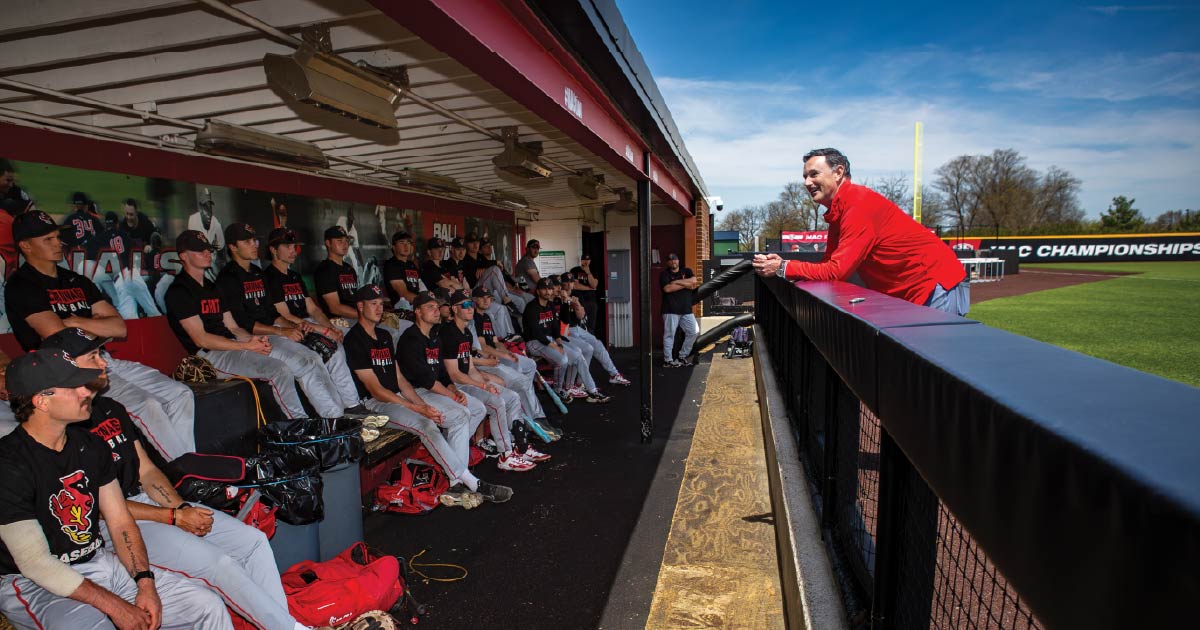
Mike Shebek, ’88, speaks to the Ball State baseball team prior to an April practice, reflecting on his playing days and the importance of giving back to the program that shaped him.
Coming soon to Shebek Stadium: new clubhouse facility
A $5 million gift from Mike and Kati Shebek will fund a new clubhouse facility for the Ball State baseball team, which will have the following features:
- Connection directly to Shebek Stadium for seamless access between the field and player facilities
- Team locker room designed for daily use and pregame preparation
- Coaches’ locker room and offices to enhance team operations
- Training and medical area for athletic treatment and injury prevention
- Player lounge and meeting space for film review, team talks, and bonding
- Laundry and equipment rooms to support day-to-day program needs
- New entryway and signage to enhance the fan and player experience

