
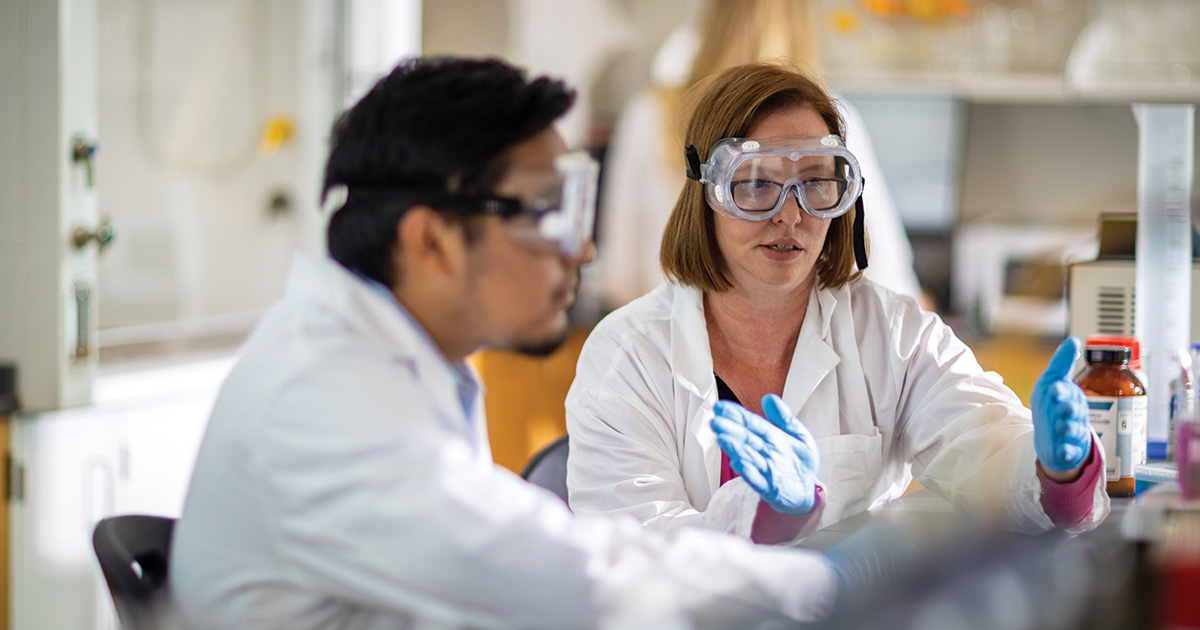
Mary Konkle, ’01, associate professor of chemistry, researches the structure and function of a protein linked to type 2 diabetes, Parkinson’s, and breast cancer. Undergraduate research at Ball State spans all disciplines—not just STEM—offering opportunities across every college.
Ball State University’s Teacher-Scholar Program pairs undergraduates with faculty mentors for hands-on research, fostering student success, graduate readiness, and lasting academic connections.
Taylor Bias thought she was just a student. Then she discovered research.
As a freshman biochemistry major, Ms. Bias joined Ball State’s Teacher-Scholar Program and began working with Dr. Mary Konkle, ’01, associate professor of chemistry. Together, they explored the protein biochemistry of MitoNEET, an enzyme involved in cellular energy production.
“The Teacher-Scholar Program set me on a path to discover my best talents and maximize my college experience,” Ms. Bias said. “It showed me how much I enjoy the rigorous problem-solving involved in research.”
That realization opened doors: national conference presentations, academic and industry internships, and a prestigious Goldwater Scholarship. Ms. Bias, ’25, continued conducting research throughout her undergraduate years and began a doctoral program in biochemistry this Fall.
She is one of many students whose academic paths were shaped by the Teacher-Scholar Program—a one-semester initiative that connects undergraduates with faculty mentors for hands-on research across disciplines.
Foundation in Mentorship
Launched in 2020 and housed within Ball State’s Office of the Vice Provost for Research, the Teacher-Scholar Program emphasizes collaborative learning, guided discovery, and meaningful mentorship. It is led by Dr. Daniele Nardi, associate professor of psychological science and program manager for undergraduate research, and Sharon Hahn, executive coordinator to the vice provost for research.
“The Teacher-Scholar model allows for a close, sustained relationship between student and faculty member that is hard to replicate in other types of experiences,” Dr. Nardi said. “It teaches students how knowledge is produced, how it is tested, and how it can make a difference.”
To qualify, students must be in their first or second year at Ball State (or first year as a transfer) and have no prior research experience. The program requires a five-hour weekly commitment and offers a $750 stipend.
Participation began modestly, with 37 students in the inaugural year, affected by COVID-19 pandemic limitations. It has grown to 139 students in the 2024-25 academic year.
Expanding Access Across Disciplines
Students in the Teacher-Scholar Program browse a database of faculty mentors and projects, then apply to work on a topic that sparks their curiosity. The program encourages exploration beyond a student’s major, and opportunities span the sciences, arts, humanities, and social sciences.
“Research can happen in a lab, but it can also happen in a studio, an archive, or out in the field,” said Dr. Nardi. “What matters is the process—asking a question, exploring evidence, and contributing something new.”
The program was designed to integrate students into faculty research or creative work. Mentors guide students through each stage of inquiry—from formulating questions to presenting findings—while also advancing their own scholarly agendas.
More than 135 faculty members across all Ball State colleges now serve as mentors in the program, and students have explored topics ranging from environmental science and digital storytelling to music composition and sociological research.
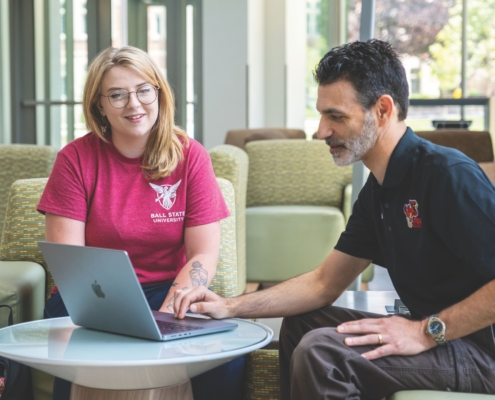
Syndal Hittson, ’25 (left), credits the Teacher-Scholar program and her mentor, Dr. Michael Tagler (right), for guiding her toward her “dream” master’s program at Ball State, which she started this Fall.
Transformative Relationships
Faculty participating in the Teacher-Scholar Program receive modest funding and professional development. But for many, the most meaningful outcome is the student-faculty bond.
“It’s deeply rewarding to watch students evolve from tentative beginners into confident scholars,” Dr. Nardi said.
That transformation was clear for Syndal Hittson, ’25, a psychological science major. She partnered with Dr. Michael Tagler to study sleep quality among college students and found that upper-level students and student employees were significantly more likely to report poor sleep.
“This study is what truly got me invested in my major and the scientific process,” Ms. Hittson said. “I had never considered myself smart or capable enough to become a scientist, but this program helped me see that I am. Dr. Tagler always believed in me and was patient while I learned, which made all the difference.”
Ms. Hittson presented at the Midwestern Psychological Association convention in Chicago and will continue her research in graduate school at Ball State.
“It’s really been a pipeline to inspire students to get involved, and stay involved, in research,” Dr. Tagler said. “And in several instances now, like with Ms. Hittson, it’s turned into an ongoing collaboration.”
Outcomes That Matter
The Teacher-Scholar Program’s impact is not only anecdotal—it’s measurable. It boasts a 92 percent average retention rate for enrollment in the subsequent term, and an 89.4 percent graduation rate. Many students go on to publish, present, or pursue graduate and professional degrees.
“When students feel like they belong—when they’re connected to a faculty mentor and see how they can contribute to real work—they’re far more likely to stay and succeed,” Dr. Nardi said.
Students who wish to continue their research beyond the initial semester may apply for additional support, such as the Pepsi Undergraduate Research and Creative Endeavor Grant.
Meanwhile, Dr. Nardi and Ms. Hahn continue to strengthen the program—expanding funding, building mentor resources, and tracking long-term student outcomes.
“We know these experiences matter,” Ms. Hahn said. “Now we’re gathering data to show just how powerful they are, and to make the case for continued investment.”
Dr. Nardi says the experience is about more than just research—it’s about helping students define their identity and find their passion and purpose.
“We’re helping students discover who they are, what they care about, and what they’re capable of contributing to the world.”
Mentor Testimonials
 “What I love about the Teacher-Scholar Program is that it allows me to engage with students outside the classroom and facilitate meaningful, hands-on learning experiences. It has been a tremendous benefit to both me and the students. My research centers around the prevention of chronic disease and promoting health for all by understanding relationships between physical health, healthy behaviors, and psychological and social factors. Involving students in this work not only deepens their academic knowledge but also empowers them to apply what they’re learning to real-world health challenges—equipping them with valuable skills and a sense of purpose that extends beyond the classroom.”
— Dr. Natalie Keirns, assistant professor of public health in the Department of Nutrition and Health Science
 “During the 2024-25 academic year, I was fortunate to work with two undergraduate students on their research projects related to disability topics. One student is researching how students with disabilities make connections in campus housing. The second is researching female college students who receive ADHD diagnoses as adults.
I was honored to guide these students in their research interests and degree goals. They were both excellent self-advocates and well-prepared for their projects. I happily shared my expertise and knowledge from nearly 20 years of experience in disability services and teaching in Women’s and Gender Studies.
My favorite part, outside of our bi-weekly meetings, was watching both of them present during CHIRPS week, Spring 2025. Neither had done presentations before, and they both did an amazing job. I look forward to seeing them continue their research and hopefully turn it into publications.”
— Dr. Courtney Jarrett, ’04 MA ’07 EdD ’12, director of disability services and instructor in Women’s and Gender Studies

