
How Burris Laboratory School Strengthened its Mission—and Shaped the Future of Lab Schools
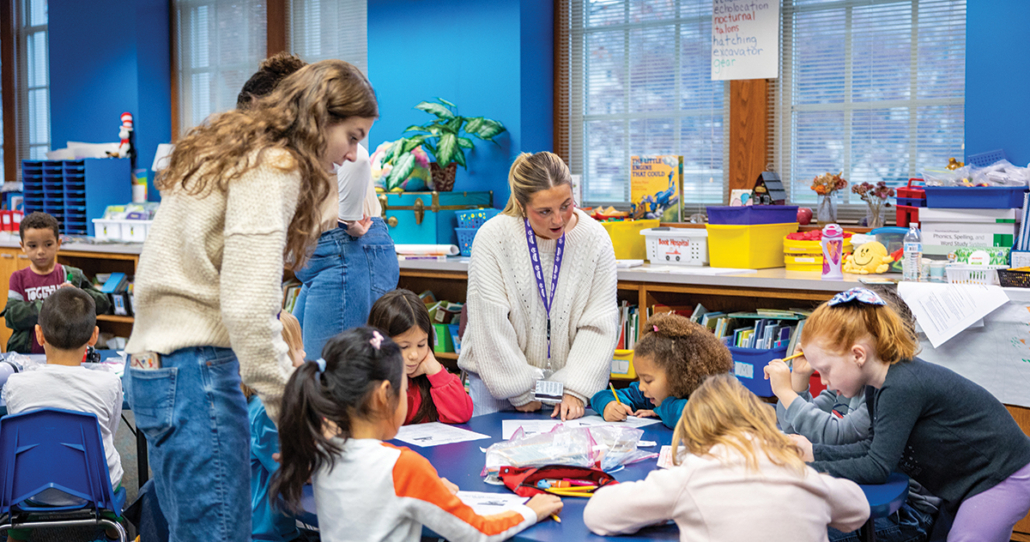
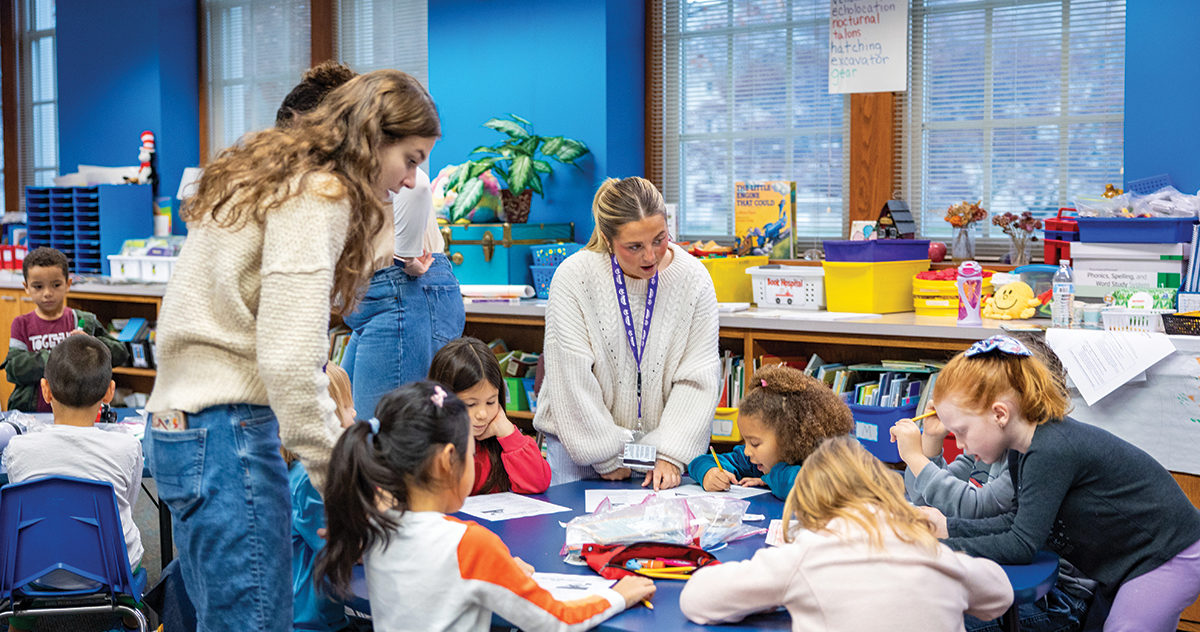
Ball State student Jillian Kriech works with Burris Laboratory School students as part of Teachers College’s Elementary and Early Childhood program, which gives future educators hands-on experience in an innovative K-12 setting. Photo by Samantha Blankenship, ’16.
Ball State University’s Burris Laboratory School has gained international recognition for innovation, fueled by student voice, faculty collaboration, and its role as a national leader in laboratory school practice.
In the Summer of 2020, just weeks into his new role as dean of Ball State University’s Teachers College, Dr. Anand R. Marri walked the halls of Burris Laboratory School for the first time. With school not yet in session, he was getting a feel for the building and its place within the University—meeting with administrators and learning more about Burris’ long-standing connection to Ball State.
As he toured the school with then–assistant principal Dr. Abigail Comber, PhD ’12, he offered a thoughtful observation that would stay with her.
“We have an opportunity to make our lab school even more distinctive,” Dr. Marri said.
It wasn’t a critique; it was a spark—one that helped catalyze a period of focused growth and renewed momentum.
At the time, Burris was known for its strong academic performance and sterling reputation among Indiana schools. But for an institution with a rich history and deep ties to Ball State, there was a shared sense among faculty and leadership that even more was possible.
“That conversation was energizing,” Dr. Comber recalled. “It encouraged us to keep asking, ‘What more can we do?’”
Deepening the Lab School Mission
When Dr. Comber became principal of Burris Laboratory School in 2021, she and Eli Jones, MAE ’22—then newly appointed as director of academic innovation and community engagement—worked alongside teachers to explore a familiar question with renewed energy: What does it truly mean to be a laboratory school in today’s educational landscape?
Burris had long been recognized for its academic strength. Test scores remained high, and the school was consistently ranked among the best in the state. But the faculty saw opportunities to more intentionally embrace the core elements of the lab school model: inquiry-based teaching, ongoing research, and a spirit of continuous experimentation. How could Burris deepen its role as a place where educational ideas are tested, shared, and refined in partnership with Ball State?
That question came into sharper focus in 2022, when Burris reengaged with the International Association of Laboratory Schools (IALS). A group of Burris teachers attended the organization’s annual conference in Alabama, where they presented on Burris’ middle school IMPACT program and its innovative, feedback-based approach to student assessment.
The response was immediate and energizing.
“We made a lot of connections. People were really impressed with what we were doing,” Dr. Comber said. “That moment made clear we were contributing something meaningful to the evolving story of lab schools.”
Shortly after the conference, Dr. Comber was invited to join the IALS board of directors. Just two years later, in 2024, Burris hosted the association’s international conference—affirming its role as a national leader in laboratory school practice and celebrating the creativity, collaboration, and continuous learning that define its faculty.
Innovation in Action
The changes at Burris weren’t incremental. They were foundational.
Teachers led a school-wide recalibration in philosophy, structure, and practice, supported by an administration committed to putting the right people in place, trusting them to create, and supporting them fully.
“We try to say yes more than we say no,” said Dr. Comber. “Our teachers are the ones designing, iterating, and doing the work every day.”
That mindset helped shape IMPACT, Burris’ middle school initiative built around inquiry-driven, project-based learning. Now in its fifth year, IMPACT blends core academic content with collaborative and real-world problem solving. It aligns with Indiana academic standards while giving students meaningful ways to apply their knowledge.
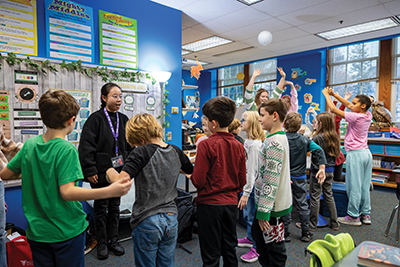
Huiqi Xie (left), a Ball State Teachers College student, leads a group activity at Burris Laboratory School—recently named Laboratory School of the Year for its innovative approach to teaching and its deep integration with Ball State’s teacher preparation programs. Photo by Samantha Blankenship, ’16.
Students in grades 6–8 work in interdisciplinary teams, guided by teacher-facilitators, to explore essential questions and develop solutions across subjects like math, science, language arts, and civics. Teachers hold regular feedback conversations with students that emphasize growth, self-reflection, and skill development. That fosters curiosity, collaboration, and individualized pacing within a rigorous academic framework.
“IMPACT gives students a chance to see themselves as learners, not just task-doers,” Mr. Jones said.
The program also emphasizes consistent student-teacher dialogue. Teachers meet regularly with students to discuss their learning, and students are invited to provide feedback in return.
Just as Burris continues to enhance opportunities for student engagement, it has also refined how it supports educators. The school implemented a reflective, lab school–specific framework for professional growth – designed by teachers—one that emphasizes collaboration, goal setting, and continuous learning.
The program’s influence is already visible. In one high school classroom, 92 percent of higher-order questions were asked by students who had previously participated in IMPACT. Student engagement has increased. So has teacher creativity, trust, and collaboration.
And while the middle school served as the launching point, IMPACT’s core principles—cross-disciplinary learning, student voice, and real-world application—are steadily expanding into Burris’ elementary and high school classrooms, driven by teachers eager to adapt and innovate.
“We wanted students to be active partners in their education. If we’re asking teachers to model innovation, we also have to ask students to engage with it.” — Dr. Abigail Comber, PhD ’12
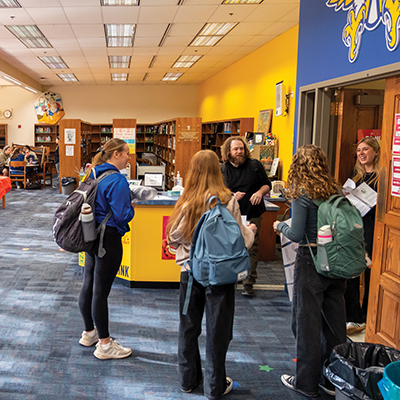
Eli Jones, MAE ’22, director of academic innovation and community engagement at Burris Laboratory School, talks with students during a library visit. In addition to supporting in-school innovation, Mr. Jones helps share Burris’ practices with educators across the country—part of the school’s growing national and international influence.
National Recognition, Global Connections
In Spring 2025, the International Association of Laboratory Schools named Burris its Laboratory School of the Year. It is an honor reserved for institutions that exemplify innovation, collaboration, and meaningful engagement with the lab school network. For Burris, the recognition was deeply affirming.
“To be named School of the Year just a year after hosting the international conference, it was a tremendous honor,” Dr. Comber said. “It affirmed the thoughtful work our faculty has done to grow, collaborate, and contribute meaningfully to the lab school community.”
The association specifically commended Burris for its commitment to student voice, teacher-led design, and the sharing of practices with peer institutions. The recognition built on Burris’ long-standing identity as a laboratory school—one that has contributed to national and international conversations about educational practice for decades.
At the 2025 IALS conference in Kingston, R.I., Burris faculty and staff presented sessions on topics such as outdoor learning, school-university collaboration, and interdisciplinary curriculum design. Earlier that year, the school also launched a new partnership with Shevington High School in England, which also extended Burris’ growing network of global connections.
“We’ve always been proud of our identity as a lab school,” Dr. Comber said. “This recognition reflects how we’ve continued to build on that foundation in ways that benefit our students and resonate with colleagues around the world.”
Ball State Connection
None of Burris’ evolution has happened in isolation. As Ball State’s university-affiliated laboratory school, Burris is deeply embedded in the academic life of the campus. Its continued growth has both shaped and been shaped by that relationship.
“We are the fifth-largest school of education in the country and the most accomplished in the state of Indiana,” said Dr. Marri, now Ball State’s provost and executive vice president for academic affairs. “Why not take that research and knowledge and apply it in meaningful, real-world contexts?”
That belief—that a university should model what it teaches—has guided the strong partnership between Burris and Teachers College. Each year, hundreds of Ball State students observe, assist, and teach in Burris classrooms. Faculty from both institutions collaborate on research, and the school serves as a site for applied professional learning, reflective practice, and instructional development.
“It’s a living laboratory,” Mr. Jones said. “Our teachers get to work closely with students, try new approaches supported by research, and reflect on what works. And Ball State students benefit from being part of that process.”
The collaboration isn’t just academic. Both Dr. Comber and Mr. Jones are Ball State graduates, as are many members of the Burris faculty and staff; many of the ideas now shaping Burris’ approach were influenced by the University’s emphasis on student agency, partnership, and professional reflection.
“It’s a reciprocal relationship,” Dr. Comber said. “We’re better because we’re part of Ball State. And hopefully, Ball State is better because it has Burris right here on campus.”
What’s Next
Even with international recognition in hand, Burris leaders and faculty are quick to emphasize that the work isn’t finished. If anything, the IALS award has deepened their commitment to thoughtful growth and community-centered learning.
The school is also exploring ways to enhance students’ early elementary experience, with an emphasis on developmentally appropriate, play-based learning in kindergarten and first grade. At the same time, new partnerships with local organizations are in development, reflecting a continued commitment to connecting global best practices with community needs in Muncie.
“Our hope is that we start to take our influence—which is so strong globally—and bring it more deeply into a local context,” said Mr. Jones, who is pursuing his doctoral degree at Ball State. “We want to be a model not just for lab schools, but for schools everywhere.”
Dr. Marri echoed that sentiment, noting that a laboratory school must remain dynamic to stay relevant.
“If the same things are happening a year from now as are happening today, I’d be disappointed,” he said. “Innovation means you’re always evolving.”
At Burris, evolution has always been part of the culture—and that mindset continues to guide what comes next.
“We’ve created something here that’s built to keep growing,” Dr. Comber said. “Our future depends on continuing to question, collaborate, and—above all—listen to our students and teachers.”


