
Ball State’s Pride of Mid-America Marching Band Builds Community Through Music
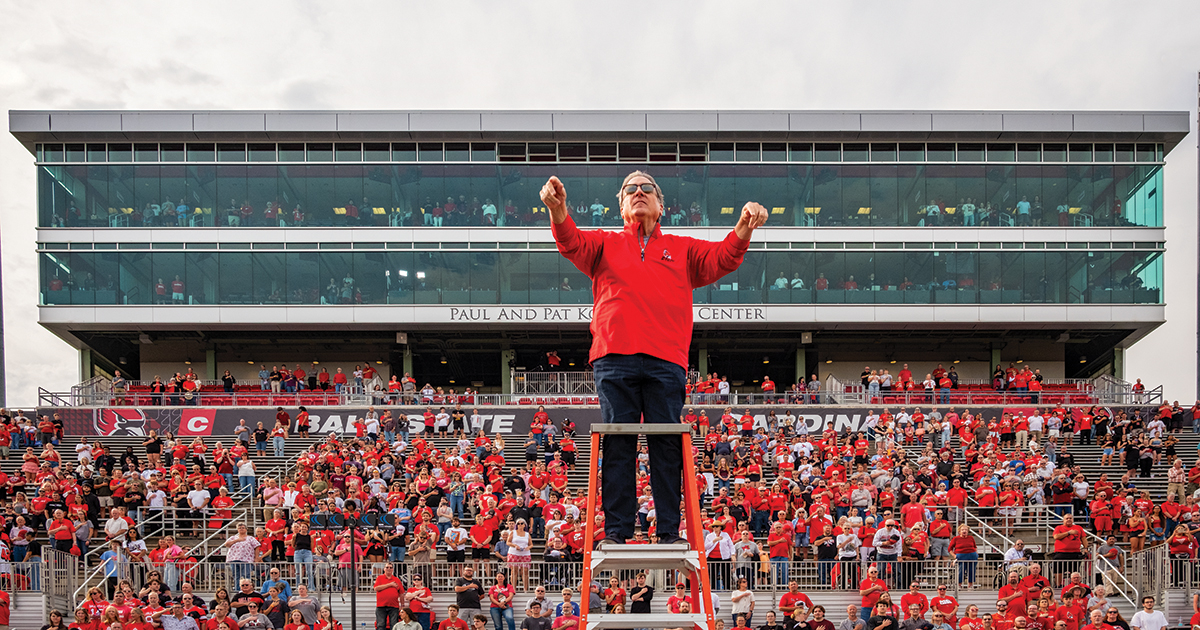
Bob Kaspar, ’81, was honored to conduct POMA at Homecoming this past Fall, the first alum invited back to do so under Dr. Jeremy Harmon’s leadership. Photo by Samantha (Blankenship) Ellis, ’15.
Ball State’s Pride of Mid-America Marching Band unites students and alumni through music, mentorship, and shared tradition while expanding opportunities for travel, facilities, and student support.
Caitlin Hummer says the Pride of Mid-America Marching Band (POMA) has been more than a performance group during her time at Ball State—it’s been a family. The sense of belonging the senior color guard captain found in POMA, she said, has defined her Ball State experience.
“Choosing to perform with POMA has undoubtedly been one of the best decisions I have made in my college career,” explained Ms. Hummer, a secondary education mathematics major. “This program has given me opportunities to join school events and find real purpose in doing what I love, with people I have grown to love.”
That sense of family is shared by students throughout the band. Senior drum major Solomon Dixon, a secondary social studies education major, said that same feeling of connection and belonging has shaped his Ball State path.
Mr. Dixon’s most rewarding moments with POMA come from seeing audience reactions. Each performance, he said, is an opportunity to be part of something larger than himself, to bring joy to others, and to connect through music.
Whether it’s inspiring a child who’s seeing a marching band for the first time or uniting a family for a special occasion, those shared moments capture the spirit of community that defines POMA.
“POMA has been the most important factor in my sense of belonging at Ball State and keeps my love of music alive even after switching majors away from music education,” Mr. Dixon said. “Every year I’ve been here has been an opportunity to share the love of music and the marching arts with talented, like-minded, hard-working individuals.”
That culture of belonging is exactly what Dr. Jeremy Harmon, who joined Ball State four years ago, works to cultivate. Under his leadership, the Pride of Mid-America Marching Band—an integral part of campus spirit since 1926—has grown in both musicianship and camaraderie.
“Many times, with college and high school marching bands, you’ll hear the word ‘family’ used frequently,” Dr. Harmon said. “Here at Ball State, the band members are very much a family to one another.”
Giving back where music began
Robert “Bob” Kaspar, ’81, who served as assistant drum major before earning degrees in accounting and management, saw his experience come full circle when he returned to conduct POMA during Homecoming 2025, and he considers being asked to conduct the National Anthem one of his highest honors.
“I didn’t come to Ball State with a career plan, but I did arrive with a clarinet,” Mr. Kaspar said. “Music gave me discipline and teamwork. Being on the football field was a terrific way to embrace campus culture.”
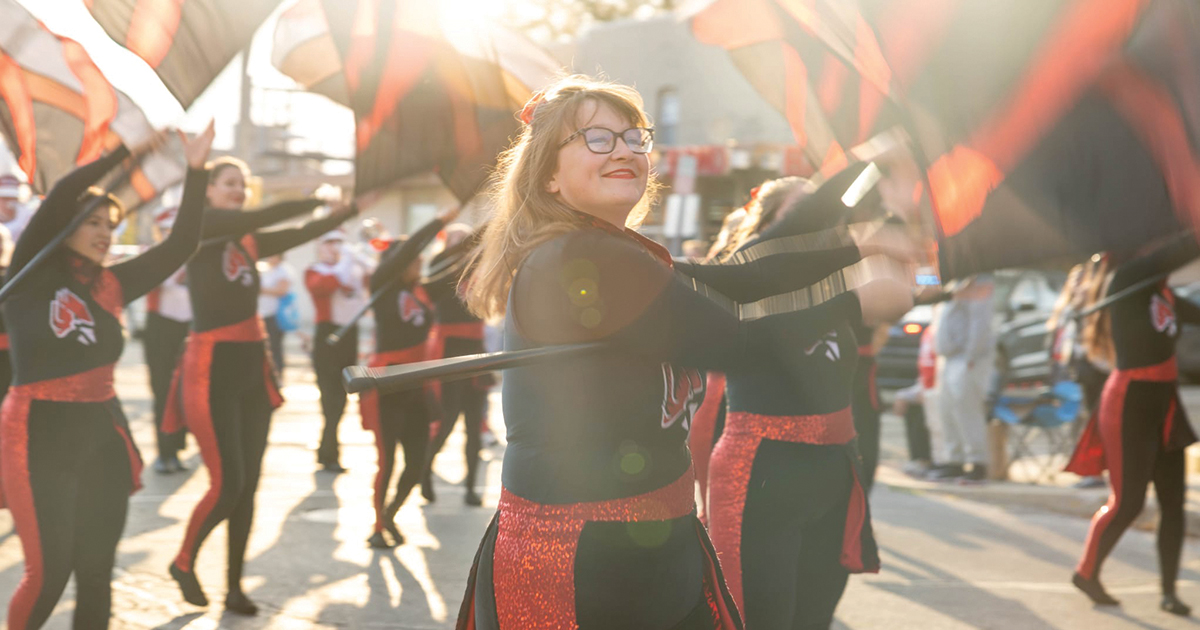
Senior Caitlin Hummer hopes to continue her love of color guard as a high school color guard director. Photo courtesy of Caitlin Hummer.
Although his professional life led him into finance, he credits the lessons of the band room with shaping his success. Mr. Kaspar and his wife, Rhonda Newport Kaspar, ’81, remain deeply involved with Ball State. He serves as chairman of the Ball State University Foundation’s Finance and Investment Committee, and together they have supported scholarships for students in Miller College of Business and the College of Fine Arts—the Robert S. Kaspar Business Scholarship and the Rhonda Newport Kaspar Dance Scholarship—as well as the University’s new Performing Arts Center, where the main theatre stage will be named the Rhonda Newport Kaspar Stage when the facility opens in Fall 2026.
“Our continued involvement is how we honor where our story began,” he said. “To return as the first alum to conduct under Dr. Harmon’s leadership was a memory I’ll never forget.”
That same connection runs through generations of Cardinals. Pete Sampson, ’99, who served as head drum major, said his time with the band remains one of his most meaningful college experiences.
“Some of my best memories from Ball State come from POMA,” Mr. Sampson said. “We were all there to support the team, our school, and to have fun playing for the crowd.”
Now in his 27th year as a high school band director, Mr. Sampson leads the Whiteland Community High School band program in Whiteland, Indiana. He said he is grateful for the lessons he learned as a student leader in POMA that continue to influence his teaching today.
“As an alum, I’ve happily donated to the Pride of Mid-America through One Ball State Day,” Mr. Sampson said. “But what means even more is seeing my former students go on to march in the group. I always encourage every student, regardless of their major, to join POMA. It’s an experience that stays with you.”
A tradition carried forward
POMA’s legacy was also shaped by Dr. Joseph Scagnoli, who became director in 1984. Over his 22 years as director of bands, he helped build the ensemble into one of Ball State’s most visible and respected symbols of excellence. Under his leadership, POMA grew to nearly 265 members and earned invitations to perform for the Indianapolis Colts, Cincinnati Bengals, Buffalo Bills, and other football programs.
“I’ve always believed the marching band represents the musical image of the University,” Dr. Scagnoli said. “When people see and hear POMA, they see the pride, teamwork, and excellence that define Ball State. The students took ownership of their performances and grew as leaders—it was more than music; it was about belonging and representing something larger than themselves.”
That sense of purpose continues today under Dr. Harmon, who is building on that foundation while creating new opportunities for students to perform, lead, and connect.
“Dr. Scagnoli created an incredible foundation,” Dr. Harmon said. “Our goal now is to rebuild that momentum and ensure our students experience the same sense of pride and purpose that defined those years.”
A new era of growth
POMA’s growth continues under Dr. Harmon’s direction, most visibly through the construction of a new conductor’s tower funded by a major grant from the John W. Anderson Foundation. Funded through a $150,000 grant, the new steel tower will replace the temporary scaffolding long used during rehearsals outside Worthen Arena. The upgraded structure will improve safety and visibility for directors and students while serving as a visual centerpiece for the program.
“It’s something that will also elevate how Ball State looks to prospective students,” Dr. Harmon said. “When a high schooler visits and sees a professional setup, it shows that we take their experience seriously.”
The project aligns with Ball State’s commitment to engaging student experiences, fostering community partnerships, and investing in facilities that reflect institutional excellence.
Although the Anderson Foundation grant covers the cost of the tower itself, Dr. Harmon said additional funding is needed for installation and future upgrades—particularly the band’s practice field, which needs leveling and resurfacing.
Travel opportunities are another top priority. Dr. Harmon hopes to expand performance experiences beyond Muncie, from regional parades to national stages. He said those opportunities can be transformational for students, especially those who have not had the chance to travel beyond Indiana.
While recent gifts and facility improvements have built momentum, Dr. Harmon said continued support remains vital.
“Our band students give so much to the University,” Dr. Harmon said. “They represent Ball State with pride, paying out-of-pocket for uniforms and equipment. It means the world when donors help us give back to them.”
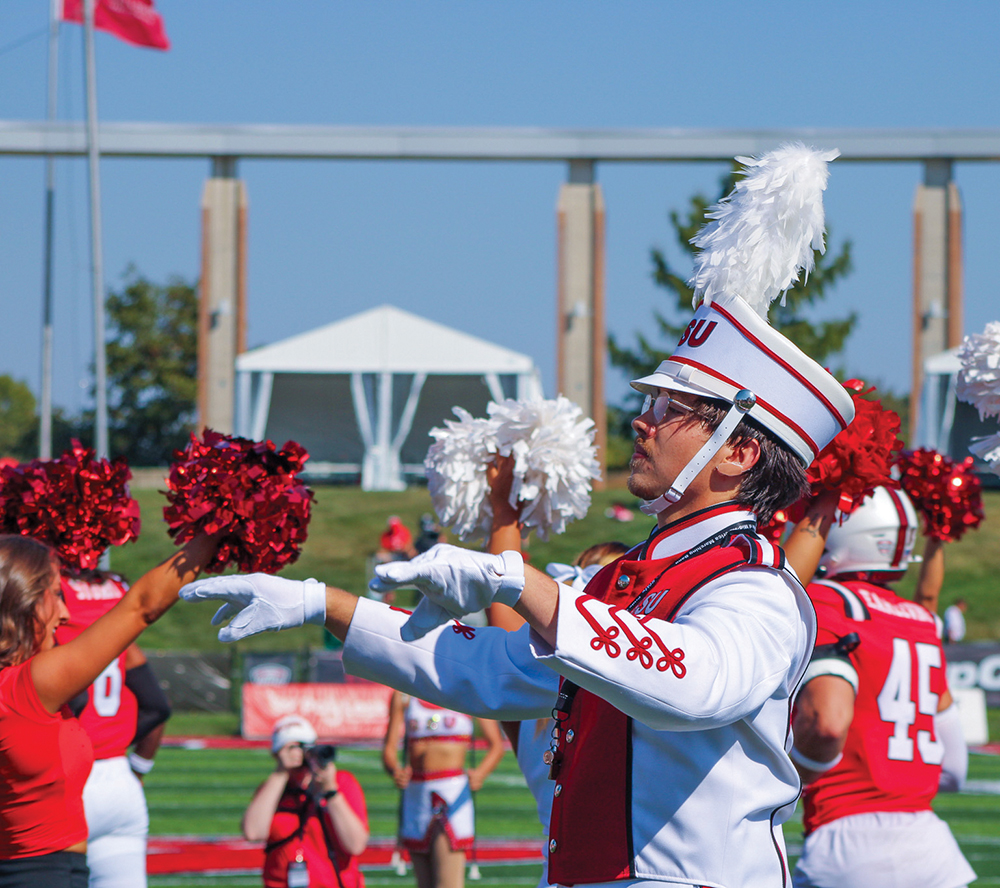
POMA matters so much to Solomon Dixon that he changed instruments to remain involved after a facial injury nearly derailed him. He aspires to become a high school band director. Photo courtesy of Solomon Dixon.
Raising the volume on support
That support is already making a difference.
Each Spring, One Ball State Day (OBSD)—Ball State’s 24-hour online fundraising event—rallies Cardinals everywhere to support the programs they love. This year’s OBSD on April 1 will spotlight the Pride of Mid-America Marching Band’s fundraising goals for field improvements and travel.
Supporters, including Lindsay Donaldson, ’07, and her family, play a key role. After the death of her father, John Scheumann, ’71—the namesake of Scheumann Stadium whose family’s lead gift also created the Scheumann Family Indoor Practice Facility, an all-weather training space for football, softball, baseball, soccer, and the Pride of Mid-America Marching Band—they broadened their giving from athletics to include education and the arts.
“Music and education are so meaningful to my mother, June,” Ms. Donaldson said. “We saw a need with the marching band and stepped in to fill it.”
June Scheumann was awarded an honorary degree from Ball State in 2024.
The Pride of Mid-America Marching Band reflects Ball State’s dedication to student engagement, service, and community. Every performance reinforces the University’s belief in turning passion into purpose. That same spirit continues long after graduation, as alumni return to cheer, mentor, and give back—ensuring future Cardinals can share in the same powerful experience that shaped their own.


