
Ball State’s Writing for Change Turns First-Year Writing Into Community Impact
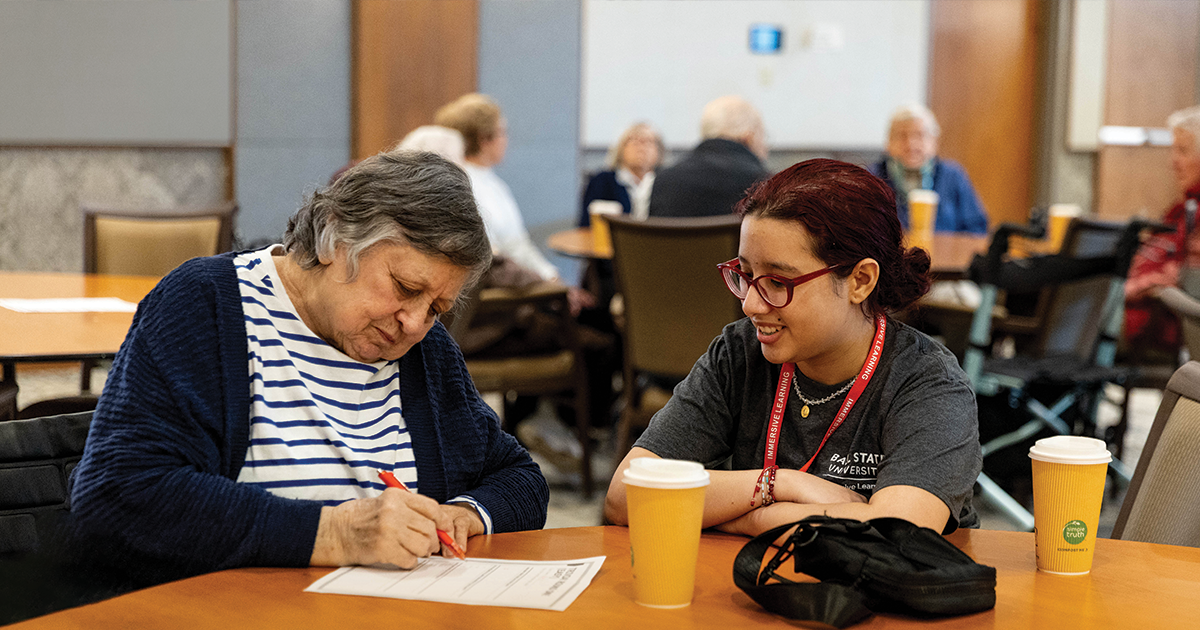
Visual art major Maria Roa Cristancho captures the story of a Westminster Village resident, preserving her lived experience.
Ball State’s Writing for Change program partners first-year composition students with local organizations, turning classroom writing into stories that build empathy, strengthen community connections, and inspire civic engagement.
Students at Ball State University are learning that writing can do far more than earn a grade—it can create understanding, build relationships, and spark change.
Through Writing for Change, students step beyond the page and into the community, discovering how language can shape lives and strengthen connections between campus and Muncie.
Created in 2020 by Dr. Jennifer Grouling Snider, professor of English and former director of the Writing Program, Writing for Change was built on the belief that meaningful community engagement can strengthen student success and belonging.
“I came across an article about how important community engagement is for retaining students,” Dr. Grouling Snider said. “I was intrigued by a model for basic writing and connected it to Ball State’s immersive learning efforts. I also wondered why immersive learning seemed focused on upper-level students rather than being incorporated into the core curriculum.”
Dr. Grouling Snider envisioned a composition course that met core English requirements while connecting students with community partners for an entire academic year. The program launched with support from faculty including Drs. Laura Romano, PhD ’14, Kathryn Ludwig, and Lyn Jones, EdD ’11 (now retired).
Now in its fifth year, Writing for Change continues under the leadership of Drs. Romano and Ludwig and Mary Lowry, ’21 MA ’23. Each class partners with a local organization, allowing students to apply rhetorical skills while serving Muncie residents.
This year, Dr. Romano’s students are working with Westminster Village, an independent and assisted living facility in Muncie, to explore ageism and foster intergenerational connection through oral histories and digital storytelling.
Dr. Ludwig’s class collaborates with Recovery Café Muncie, a peer-based community in downtown Muncie that provides a safe, supportive space for people recovering from homelessness, substance use, mental health challenges, and trauma.
“Because of these immersive projects, our members have had their voices heard and their recovery journeys respected,” said Abby Gluvna, Recovery Café’s executive director. “Dr. Ludwig and her students bring compassion, authenticity, and an excited spirit that uplifts our community.”
Ms. Lowry’s students partner with the Muncie Mission, strengthening outreach and promoting its annual Walk a Mile in My Shoes fundraiser each February.
Across all sections, Writing for Change deepens students’ sense of purpose.
“It’s not just about essays,” Dr. Romano said. “To me, the single most meaningful thing about Writing for Change is that it makes our students think about who they want to be—as a citizen, as a person. It gets them thinking about being productive, someone who helps others, and leaves a positive mark on this world.”


