
Indiana Communities Institute at Ball State Builds Stronger Communities Statewide
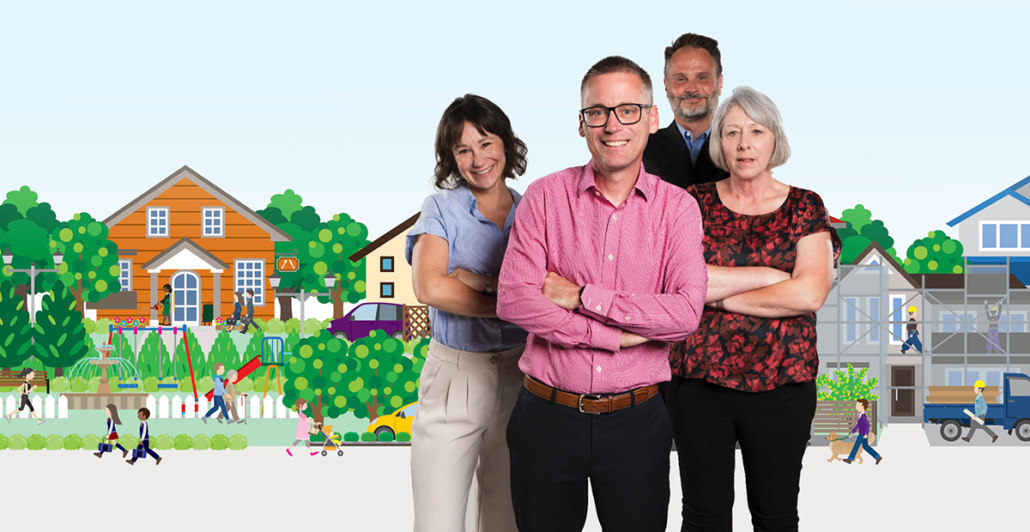
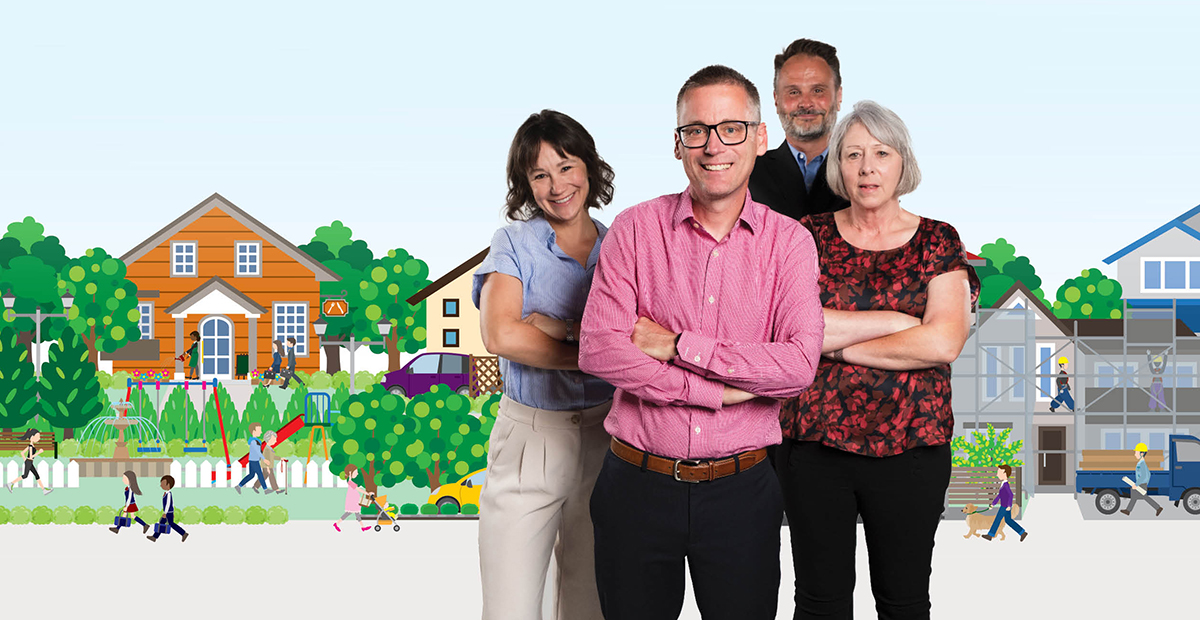
Indiana Communities Institute (ICI)—part of Ball State’s Miller College of Business—has a core staff of four people. Pictured left to right: Kara Riggleman, ICI’s community development program manager; Brian Blackford, ’01 MPA ’19, ICI’s executive director; Geoff Schomacker, ICI’s associate director for strategic development; and Angie Popplewell, ’05, ICI’s director of operations.
Through training, research, and community-driven planning, Ball State University’s Indiana Communities Institute equips local leaders across Indiana to strengthen quality of place, foster economic development, and build vibrant communities.
When community members and local leaders come together to shape a shared vision for their hometown—its identity, culture, and future—the result can spark lasting change. But knowing where to begin isn’t always easy.
That’s where Ball State University steps in. Deeply rooted in Ball State’s commitment to lifetime learning, impactful service to communities, and Indiana’s success, the University’s Indiana Communities Institute (ICI) is a trusted partner to local and regional leaders from cities, suburbs, urban, and rural areas across the state who strive to create stronger, more vibrant places to live, work, and visit. The partnership is built on collaboration, research, and the belief that thriving communities can be created with the right tools and guidance.
Part of Ball State’s Miller College of Business, ICI collaborates with numerous experts and talented professionals from across the University, including the Center for Business and Economic Research, Rural Policy Research Institute, Bowen Center for Public Affairs, and Estopinal College of Architecture and Planning. These experts provide research, technical resources, guidance, and professional knowledge to support ICI’s wide range of programs and services.
With its vision of better communities for more people, ICI offers local leaders’ expertise, guidance, and a variety of tools—including meaningful educational experiences delivered through the ICI Academy training or customized, community-driven initiatives and insights. Training topics range from local finance and economics to how to meaningfully engage with people in ways that inform visioning for the future.
“Our training programs are designed to meet people where they are, and to help them go further than they thought possible,” said Brian Blackford, ’01 MPA ’19, Indiana Communities Institute’s executive director. “We want to help community leaders, members, and volunteers learn about what impacts their communities. When people have access to knowledge and support, they become catalysts for real and lasting change.
“Largely, our role is to help connect resources and expertise from Ball State with partners primarily in communities around Indiana, sometimes beyond, who are working in the community development or economic development space,” Mr. Blackford added. “We want to help them build capacity, get the training, and have the research they need to improve the places they live.”
In addition to training, ICI helps create, develop, and implement community-based projects. The projects vary—one might center on assisting local stakeholders in better understanding the issues and opportunities facing them. Another might focus on sharing positive stories about neighborhoods and residents. Others might focus on placemaking, investments in public spaces, arts, tourism, and business development.
But before any assistance is offered, there must be an invitation.
“ICI’s first rule is we only go where we’re invited,” Mr. Blackford said.
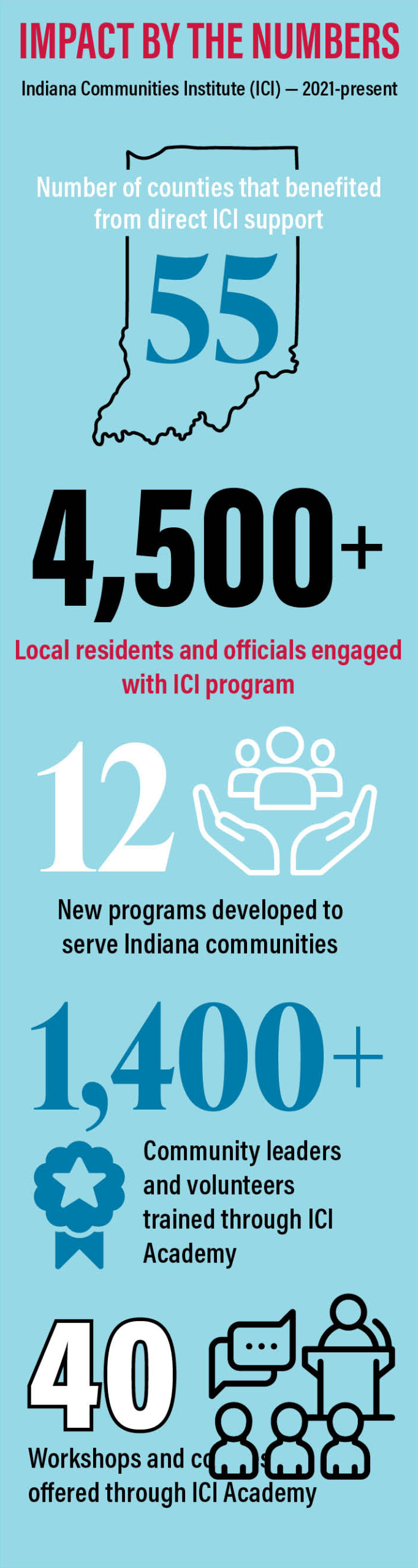
The institute has been approached for help often, and its reach has continued to grow over the years. On average, ICI supports community-based work—including multiyear projects—in about 25 Indiana counties and provides various trainings to approximately 500 Hoosiers from across the state each year. ICI also innovates a handful of programs and processes annually.
Engaging community members
Although Leeann Wright had worked for and with non-profits for 20 years, she had not been in a community development role before working at the Community Foundation of Pulaski County in Winamac, Ind. So, in 2023, she took ICI’s Community Development Course.
“I’m a lifetime learner, and I knew I needed some help,” said Ms. Wright, now the foundation’s executive director. “ICI is the best of the best. It’s where I knew I would get knowledge, guidance, and expertise.”
What excited her the most about this course were the discussions on how to actively engage community members who usually don’t make their voices heard. As her role with her county’s Community Foundation grew, she asked ICI for help with some of her county’s strategic visioning—particularly on addressing some social, economic development, and community development issues, Ms. Wright said.
“We needed support to create an action plan to address those issues. So ICI came in and did a strategic visioning session,” Ms. Wright explained. “We held five listening sessions with the public, and now the county is ready to enter the comprehensive planning stage.”
Through it all, she has consistently considered how to engage people in fruitful discussions about their shared community and its quality of place, with the understanding that from there, economic growth can occur.
“People don’t follow jobs. Jobs follow people. We have to make our community welcoming and have a high quality of place,” Ms. Wright said. “It’s the amenities. Do we have enough service providers, enough safe and welcoming places for kids to gather and play, and enough parks, for example? But it’s also understanding our culture and how newcomers might experience it. By that, I mean when someone is walking down Main Street, are people tapping on their phones constantly, or will people look up and wave hello and stop for a quick chat?
“But we need to have conversations about these sorts of things within our community,” she continued. “After what I learned in the ICI course I took, I’m always actively thinking about how to get more people at the table where visioning and strategy are being talked about to make sure their voices are heard.”
And how will she do that? By staying curious about people.
“Ask them non-intrusive questions,” she explained. “To build relationships, you have to be present, ask questions, be curious, be sincere, and reach out consistently. Show up in the places where people are and don’t expect them to come to you.”
Driving economic, community development
Dr. Ceann Bales, MPA ’01, currently the executive director of the Jay County Development Corporation, completed two ICI workshops. One workshop offered economic development training, and the other focused on community development.
In 2019, the community where she lived and worked at the time, Randolph County, Ind., sought ICI’s assistance and expertise on the county’s “Cultivating Community” initiative. Except for a brief period during the COVID-19 pandemic, ICI has offered guidance on this initiative for six years.
“ICI came in and helped us with community engagement, and helped us come up with an overall economic and community development plan and look at what Randolph County residents want,” said Dr. Bales, who at the time was the executive director of the Randolph County Economic Development Corporation (now known as Randolph County United).
“The most important thing that ICI emphasized to us is that if we want to attract and retain individuals in our community, success in doing that is no longer solely dependent on jobs. It also centers on our community’s quality of life, place-making, and our pride and love for our community,” Dr. Bales said. “ICI really helped us rethink how we define quality of life and quality of place in Randolph County. We took a hard look at what it means to make our community a place where people whose families have been here for generations want to stay—and where new people want to move and set down roots.”
After gathering input from residents, county leaders developed a plan built around five core pillars—including one focused on quality of life. A committee was formed to explore the development of a future trail network, and the county also created a brochure to highlight its local parks.
But according to Dr. Bales, one of the most meaningful outcomes of ICI’s involvement was how it helped leaders engage directly with the community. More than 250 residents participated in planning sessions and shared ideas that helped shape the county’s direction.
“People who typically might not have been involved became engaged,” Dr. Bales said. “It was wonderful, for those of us who had been doing this type of work in our community for a long time, to have people come to the table that we had never worked with before.
“It’s really a thoughtful, intentional, and engaging process to allow all people’s voices to be heard in a community.”
Dr. Bales, who earned her master’s degree in public administration from Ball State’s College of Sciences and Humanities, takes pride in knowing the University offers resources, guidance, and expertise that help communities.
“I am so proud that Ball State—which played such an important role in my education and my professional career—really walks the walk when it comes to truly believing in Indiana, continual education beyond the campus, and understanding the important role that rural communities and other communities in Indiana play in the health and future of our state,” she said.
“Knowing that Ball State supports ICI in doing this work shows that this University is committed to the lifelong journey of not only its alums but also the other residents of the State of Indiana.”


