
Ball State Business Students Make a Difference Through Immersive Learning
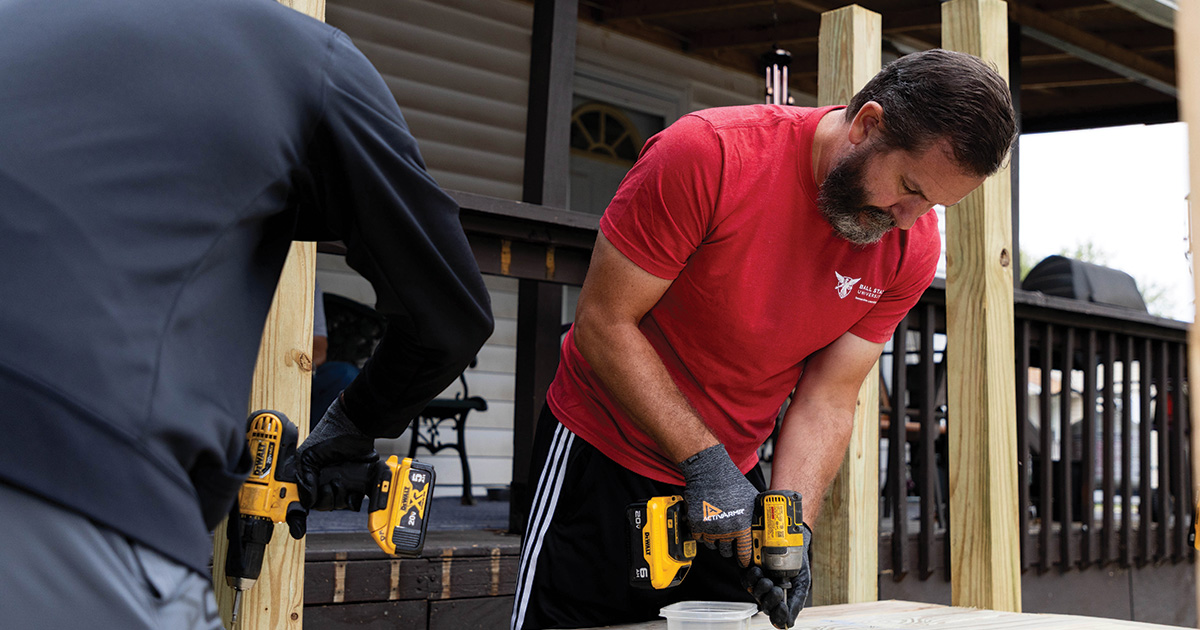
Dr. Ben Angelo, assistant professor of accounting, assists with a Home Savers of Delaware County construction project. Through the Immersive Learning partnership, students apply business skills while supporting the nonprofit’s work for local homeowners.
Miller College of Business students apply accounting, hospitality, and tax-preparation skills through Immersive Learning projects that strengthen nonprofits and serve families across Muncie.
The work began with spreadsheets, financial reports, and a strategic plan. Then the accounting students picked up drills.
At a Delaware County home, Ball State University students and faculty members measured lumber, cut boards, and drove screws into an accessibility ramp, helping a homeowner move safely in and out of the house. For students in Accounting 430, the project made visible the purpose behind months of work supporting Home Savers of Delaware County.
“If I’m able to offer some suggestions that improve the organization, that means more people are going to have heat, more people are going to have accessibility to their home,” said Dr. Ben Angelo, assistant professor of accounting.
Across Ball State University’s Miller College of Business, students are discovering that business knowledge can help families remain in their homes, put food on tables, and navigate tax season.
Dr. Angelo, Christiana Mann, ’94 MA ’97, and Dr. Jason Stanfield, MBA ’07, have built Immersive Learning experiences connecting professional preparation, personal purpose, and community needs. Ms. Mann and Dr. Stanfield have received Ball State Immersive Learning Faculty Awards for projects that place students alongside community partners to produce work that matters.
For Dr. Angelo’s students, the relationship with Home Savers has continued for three consecutive semesters. The nonprofit makes urgent repairs and accessibility improvements for low-income homeowners, addressing needs such as failed furnaces, broken plumbing, and wheelchair ramps.
Students have operated much like members of the organization’s executive team, reviewing finances, managing bookkeeping, and pursuing grant funding. They have also joined the physical work, building ramps and helping Home Savers assist approximately 30 homeowners over the past year.
That combination matters: A financial statement can appear abstract in a classroom, but in a community organization, every improvement can mean another person is able to remain safely at home.
“It wasn’t just busy work,” said Logan Dolbee, ’25, an accounting graduate who participated in the project. “It was actual hands-on [work], getting to see the impact that the work we were doing had on the organization.”
In Hospitality 101, Ms. Mann’s Cook with Purpose project begins with another basic need: food. Students prepare meals for people experiencing food insecurity, partnering with organizations such as the Avondale Neighborhood Association and Soup Kitchen of Muncie.
Cooking is only one part of the work: Students must account for dietary needs, food safety, transportation, and volume forecasting. In one community meal, they helped serve approximately 200 people in Avondale.
Ms. Mann brings more than 40 years of food-service experience to the classroom, but her lessons extend well beyond technique.
“It’s really not about the food,” she said. “Yes, I’m here to teach you skills and to talk about food. But it’s time management, organization, positive attitude, communication, and critical thinking.” — Christiana Mann, Assistant Lecturer of Hospitality Innovation and Leadership
Food insecurity, she said, is a “pillar” of her work, which includes teaching students to minimize waste and safely transport unused food to organizations that can distribute it. For many students, Cook with Purpose is their first chance to see hospitality as a way to serve others.
In Accounting 415, Dr. Stanfield’s students provide another service with an immediate financial effect. Through the IRS Volunteer Income Tax Assistance (VITA) program, they prepare and electronically file state and federal returns for qualifying taxpayers.
In 2026, the students prepared tax returns for more than 250 clients, saving lower-income filers an estimated $40,000 in preparation fees. Clients included Ball State community members, Muncie Community Schools families, and other Delaware County residents.
“The students know this work matters because there is a real person sitting across from them who is counting on them to get it right,” Dr. Stanfield said. “They build technical knowledge, confidence, and client-service skills while providing a service that can make a meaningful financial difference for individuals and families in our community.”
Each return is reviewed by an IRS-certified quality reviewer before filing.
Together, the three experiences reflect a broader approach within Miller College: Students learn business by doing business, solving real problems, and gaining a clearer sense of how their abilities can serve others.
“I am grateful to Ben, Christiana, and Jason for creating experiences that allow our students to apply what they are learning in service to others,” said Dr. Cathy DuBois, Bryan Dean of the Miller College of Business. “Immersive Learning helps students build professional skills, confidence, and a clearer sense of purpose. At the same time, their work strengthens the community organizations that place their trust in us.”
Sometimes the result is a completed tax return or a meal served. Sometimes it is a stronger financial system or a more sustainable nonprofit. And sometimes it is a ramp leading to someone’s front door.
For students, those outcomes answer a question larger than any single assignment: What can I do with what I know?
Across these courses, the answer is making a difference.
An Enduring Commitment
Ball State’s commitment to Immersive Learning was built intentionally—and sustained over time.
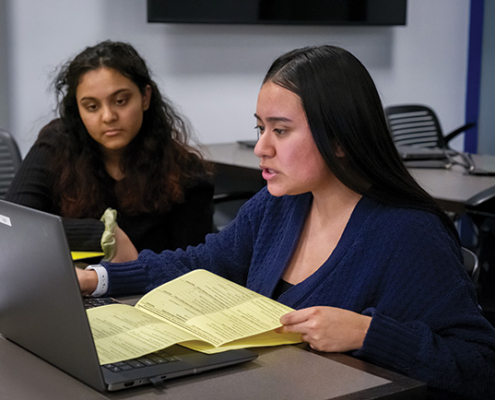
Lindsay Sanchez, ’23 MS ’25 (right), reviews tax documents with a client as part of Ball State’s Volunteer Income Tax Assistance (VITA) program.
In 2007, Ball State was the only Indiana public university to receive state funding specifically to enhance its curriculum, including $1 million for Immersive Learning. Philanthropic support followed, and the University’s Ball State Bold campaign later designated $40 million to create 100 additional Immersive Learning experiences.
By 2012, 44 departments across all seven colleges had coordinated more than 700 Immersive Learning projects involving nearly 12,000 students. That momentum has continued: During the 2024-25 academic year alone, more than 2,700 students participated in experiences connecting classroom learning with careers, communities, and service across Indiana.
That investment continues through Our Call to Beneficence: The Campaign for Ball State University. Since its public launch in 2023, the campaign has included enriching the academic experience among its three principal priorities. More than $64 million has supported academic programs and high-impact practices that distinguish a Ball State education.
Ball State’s current strategic plan carries that commitment forward, calling for every undergraduate to complete a course incorporating Immersive Learning or another high-impact practice.


