
AI Tools Are Helping Ball State Clinics Put Patients First
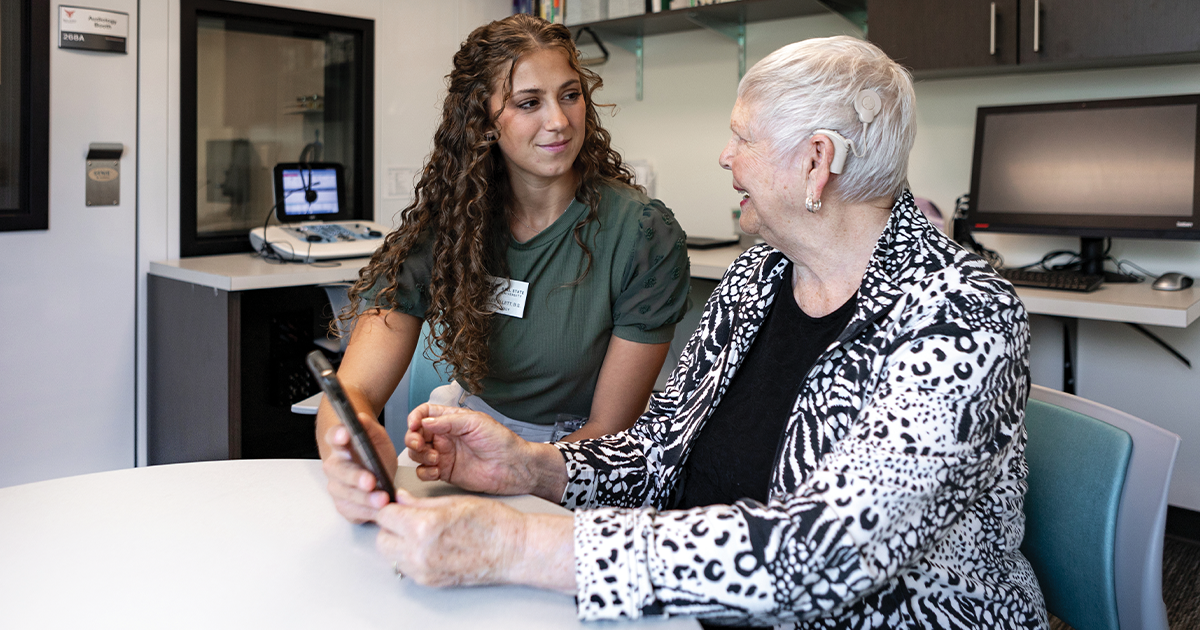
Dr. Rylee Ellett, ’21 AuD ’25, (left) consults with a patient at Ball State’s Interprofessional Community Clinics, where AI tools help streamline documentation and support communication, allowing clinicians to focus more on patient care.
At Ball State’s Interprofessional Community Clinics, AI tools help students streamline documentation, support Spanish-speaking patients, and spend more time focused on patient care.
At Ball State University’s Interprofessional Community Clinics (ICC), artificial intelligence (AI) is reshaping how patients are cared for and how future healthcare providers are trained.
By weaving AI tools into everyday clinical practice, the ICC is reducing administrative burdens, expanding access for Spanish-speaking patients, and giving students more time to focus on the people in front of them.
“If you look at some of the data with AI, what it’s allowing clinicians to do in real time is to spend a little less time on the administrative piece, such as documentation, and to give them a little more face-to-face time with the actual patient,” said Dr. Blair Mattern, ’06 MS ’10, associate dean for clinical affairs and clinical professor of audiology. “You think about AI being a technical tool, but it actually will increase the humanistic side of healthcare, because we’re putting our clinicians in front of people more often.”
At the ICC, AI is being utilized in various ways, including automatically transcribing patient-provider conversations, structuring documentation, and providing language translations, which significantly benefits the ICC’s growing Spanish-speaking patient base. Additionally, AI can offer healthcare providers real-time recommendations for diagnosis, treatment, and referrals, adding another layer of critical thinking for the clinician.
This innovative approach to healthcare—used ethically, legally, and responsibly—allows students to see how emerging technologies can support compassionate, community-focused care. For students, it’s a hands-on lesson in how emerging technology can enhance compassionate, community-focused healthcare.
Dr. Mattern has spearheaded the effort to incorporate AI into the ICC, doing so in a measured and focused way.
“We’re taking it step by step,” Dr. Mattern said. “We want to make sure that we, as faculty and administrators, have a firm grasp on AI, particularly in healthcare. We’re embracing AI because it’s here, and if our students are not going to learn it here, they will probably learn it within 12 months of being out in the field when they’re licensed practitioners.”
Ball State’s College of Health has been thoughtful about the use of AI. The adoption of this technology demonstrates to students and partners that it is preparing future graduates for successful practice in the years to come.
For Ball State, the use of AI in its clinics directly correlates to its strategic plan, Destination 2040: Our Flight Path, through its community engagement and societal impact.
“Ultimately, our students are better prepared, and our patients are better cared for because we’re using it,” Dr. Mattern said.


